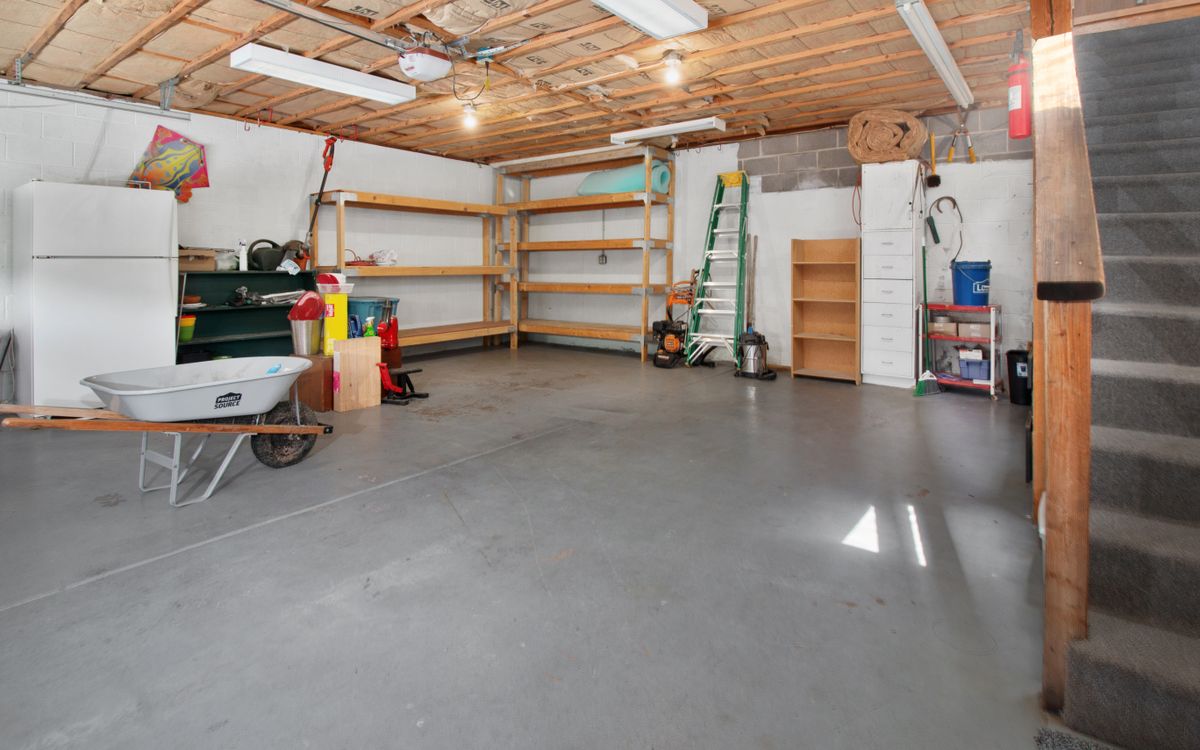
A garage is the hardest storage environment in a house. It drops below freezing, it takes a stack of forty pounds, it gets opened to the weather several times a day, and it is where everything you cannot decide about ends up. The bins sold for it are usually designed for a bedroom closet, where none of those conditions apply.
This piece compares three clear bins that are commonly bought for garage shelving, and works from the two things that decide whether a cold-weather stack survives: what the plastic is, and how the lid meets the bin below it.
What cold actually does to a storage bin
Plastic does not become brittle at one temperature. Each polymer has a glass transition range where it stops behaving flexibly, and for polypropylene it sits far below any garage temperature — which is why a polypropylene bin left outside in January is still serviceable.
The failures that do happen in cold garages come from three other places. The first is mixed or recycled polymer blends, which are cheaper and can behave very differently from virgin polypropylene at low temperature. The second is the latch tab, a thin section that concentrates stress; a bin whose lid is bowed by overloading will crack at the tab rather than at the base. The third is thermal cycling — the repeated expansion and contraction of a stack that is loaded when warm and cold when not, which works fasteners and lid seams loose over a few seasons.
None of this is visible when you look at a bin in a shop. It is visible in the specification: the material line, the presence or absence of a load rating, and whether the lid is recessed or flat.
Why the lid geometry matters more than the wall thickness
A flat lid on a flat rim gives you a stack that depends entirely on friction. A slight nudge moves the bin above, the stack loses alignment, and the whole column leans.
A recessed lid — one with a shallow well in the top that the base of the bin above sits inside — turns the stack into a set of nested joints. The bin above cannot slide laterally because its base is captured by the well. That single feature does more for stack stability in a garage than any amount of extra wall thickness.
The Sterilite 64 Qt Latching Box uses this geometry, and it is also why the 32 qt and 64 qt versions can share one lid: the well is the same, so a shallow bin can sit on a deep one and the footprint stays consistent.
The three bins, and what each one is actually for

Sterilite 64 Qt Latching Box (1497)
The deep option. Outside it measures 23.75 × 16 × 13.5 inches, and the interior at the bottom is 19.375 × 13.125 × 13 inches — which is the number that matters, because the sides taper. Thirteen inches of interior height takes a pair of tall boots standing upright, a folded duvet, or a stack of four jumper-sized bundles.
The material is polypropylene, the lid is recessed with two latches, and one latch can be released while the other acts as a hinge — a genuinely useful detail when you are holding something in the other hand.
What it does not have is a published load rating. Sterilite’s own guidance is to keep the heaviest bin at the bottom and to use judgement when stacking. That is honest, but it means the number you need does not exist, and you have to judge by flex: load the bottom bin, look at the lid line, and stop adding as soon as it bows.
Owner reviews on Sterilite’s product page are worth reading for the failure mode rather than the star average. The recurring complaint is a cracked latch on an overloaded bin, and at least one reviewer summarises the working limit as keeping the load light and the stack shallow. That is consistent with the design: the latch tab is the thin section, and the tab is what fails.
IRIS USA 32 Qt Stack and Pull (500207)
This is the only bin in this comparison with a published per-bin load figure: 20 pounds, stated by IRIS. Twenty pounds is a light load. It is right for linen, seasonal clothing, craft supplies and paperwork, and wrong for tools, paint or anything dense.
Its distinguishing feature is the pull handle moulded into the base. In a garage with shelving at chest height, that handle changes how you use the shelf: you slide the bin forward instead of lifting it over the lip, which means you do not have to unload the bins above to get at the one in the middle.
Outside dimensions are 18.8 × 14.4 × 10.5 inches, and the bins nest flat when empty — useful if you buy a set for one season and store the empties for the rest of the year.
The limitation is the height. At 10.5 inches outside, interior height is roughly 9.5 inches, which will not take a boot standing up. This is a folded-goods bin.
IRIS USA 32 Qt Storage Container with Latching Lid (500297)
The same capacity in a four-pack, at 18.75 × 14.38 × 10.5 inches outside and 1.92 pounds empty. The lid has indexed grooves rather than a deep well, which does less for lateral stability than a recessed lid but more than a flat one, and the buckle latches pull the lid down evenly at both ends.
The case of four is the point. A garage wall of shelving looks and works better when every bin on it is the same height and the same footprint, and buying four identical bins in one order is the cheapest way to get that. Mixed sizes on one shelf is the most common reason a garage wall stops being usable.
No published load rating here either, so the same flex test applies.
Stacking: what the numbers allow
Any article that tells you “stack bins four high” without naming the bin and the load is guessing. Three limits actually apply, and the lowest one wins.
The first is the manufacturer’s stated guidance. Sterilite says keep the heaviest at the bottom; IRIS publishes a 20 lb figure for one model. Where nothing is published, there is no rating — not an unlimited one.
The second is lid flex. Load the bottom bin, look along the lid seam, and stop adding weight when the line stops being straight. A bowed lid is a latch crack waiting for a cold night.
The third is reach height. A stack whose top bin is above eye level stops being storage and becomes a place you put things once. In a garage with a 7-foot ceiling and a shelf at 5 feet, that usually means two bins, not four.
Light, dust and the case against clear
Clear bins are the right default for a garage because inventory is the main problem there. You cannot see the label on a bin at the back of a shelf, but you can see the shape and colour of the contents through the wall, which is often enough.
The cost of clear is light exposure. For most garage contents — tools, seasonal clothing, camping gear, paint — that is irrelevant. For anything UV-sensitive, an inner opaque bag is a better answer than giving up visibility across the whole stack.
Dust is the other consideration. A latching lid that pulls down at both ends keeps dust and insects out far better than a lid that simply rests on the rim, which is the argument for the buckle latches on both IRIS models over a plain lidded tub.
What the price comparison actually says
At around $17 for the 64 qt and around $13 for either 32 qt model, the difference between these three is small enough that price should not decide it. What should decide it is which bin matches the shelf you own.
The 64 qt at 23.75 inches long needs a shelf at least 24 inches deep and 25 inches wide to sit one-across. The 32 qt models at 18.75 to 18.8 inches long will fit a 20-inch shelf with room to spare, and two of them side by side need about 38 inches of width.
Measure the shelf before choosing the bin. A bin that overhangs by half an inch at the front is a bin whose lid will not seat properly against the one above it.
The shortlist
For a cold garage with a deep shelf and heavy contents, the Sterilite 64 Qt Latching Box is the one to start with, on the strength of its recessed lid and 13-inch interior height — provided you keep the stack shallow and the load within what the latch can carry.
For a mid-height shelf holding folded goods, the IRIS USA 32 Qt Stack and Pull is the better ergonomics: the base handle means you use the shelf instead of avoiding it, and it is the only bin here with a stated load figure.
For a wall of shelving that needs to look and behave as one system, the IRIS 32 Qt four-pack gets you there in a single order, with lids that hold alignment better than a flat design.
Whichever you pick, the two measurements to take first are the shelf depth and the clear height between shelves. If the cold is the specific worry, the material line on the listing — polypropylene, not “recycled blend” — is the one specification worth checking twice. For the load side of the same problem, wall shelving load ratings covers the fixing rather than the bin, and how high a tote stack can go covers the geometry.