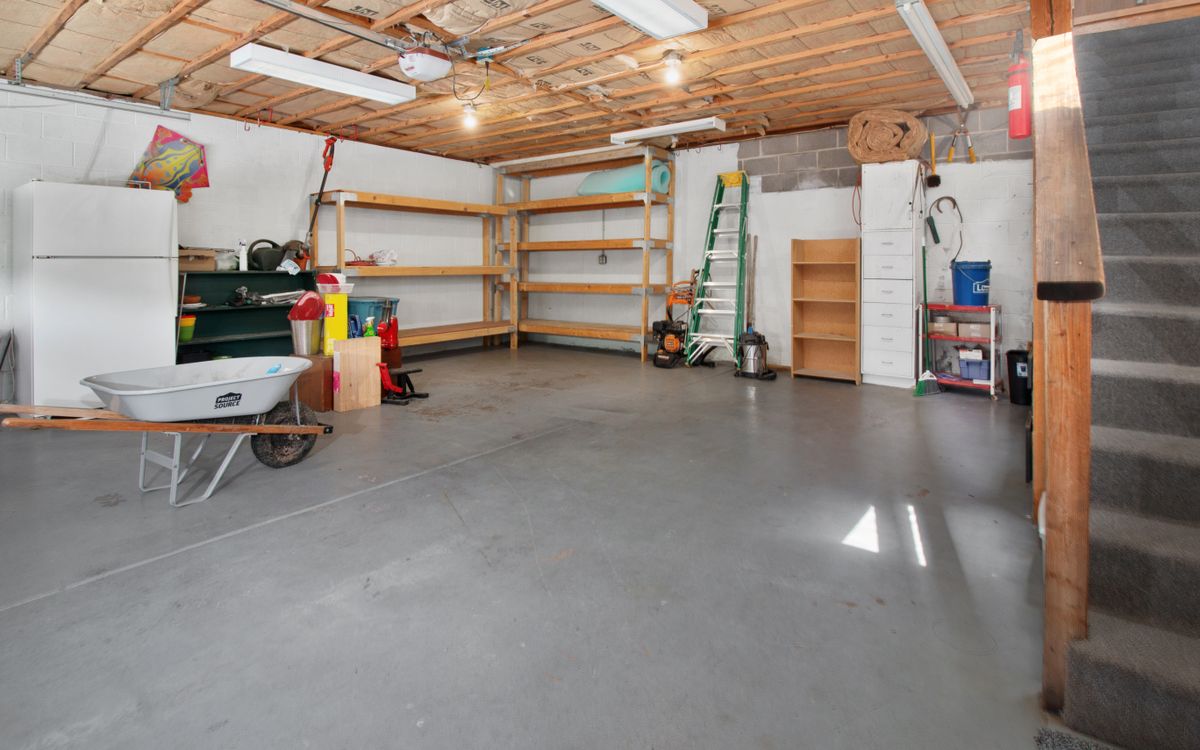
A bicycle is the most awkward object in a normal garage: about six feet long, two feet wide at the bars, and light enough that moving it is easy but heavy enough that lifting it overhead twice a day gets old. Five bikes standing on the floor take about 15 square feet of slab; hung at one height on a wall, the same five need ten feet of it. Most garages have one of those and not the other.
The decision is not which rack looks best. It is which of three resources you are willing to spend — floor, wall or ceiling — and how much time you are willing to add to every ride. This piece works through the three, starting with the dimensions of the bike itself, because every rack decision is a division problem against those.
What one bike actually occupies
An adult bike measures roughly 66 to 72 inches from the front tyre to the rear tyre, depending on wheelbase and frame size. It stands about 40 inches at the bars, and a typical non-electric adult bike weighs 25 to 30 lb.
Three of those numbers matter for storage and one does not. Length decides how much wall or ceiling run a single bike consumes. Bar width decides how far it projects from a wall — at the 24-inch bar width rack makers use as their reference, a bike parallel to a wall stands about 12 inches off it. Height decides whether it fits under a shelf, a bench or a door track. Weight decides which hooks and hoists are rated for it, and it is the number most often ignored.
Bar width is where the reference figures and real bikes part company. A mountain bike with 780 mm bars measures about 30 inches across, which is six inches wider than the reference and pushes the projection from 12 inches to 15. Measure your bars before you plan a wall of racks, because that six inches multiplies by the number of bikes.
Three systems, three footprints
| System | Floor | Wall | Ceiling | Retrieval |
|---|---|---|---|---|
| Floor stand | 24 × 18 in per bike | none | none | Roll in, roll out |
| Vertical wall rack | none | 24 in per bike | none | Lift front wheel, pivot |
| Horizontal wall hooks | none | 70 in per bike | none | Lift whole bike overhead |
| Ceiling hoist | none | none | 70 × 24 in per bike | Pull rope, hook frame |
Vertical wall racks are the densest wall option and the one with published spacing. Steadyrack lists 24 inches between bikes at the same height, 14 inches for staggered road bikes, 16 inches for staggered mountain bikes and 47 inches for the full-pivot arrangement, all measured assuming a 24-inch handlebar. The Classic MTB model is rated to 35 kg, or 77 lb, and takes 24 to 29 inch wheels with tyres from 2.1 to 2.8 inches wide.
Ceiling hoists are a different class of product: most are rated at 50 lb, fit ceilings up to 12 feet, and use a rope cleat rather than a winch. Fifty pounds is a generous margin over a 30 lb bike and not much margin over an e-bike, which is where the ratings start to matter.

Aisle width decides the layout
Thirty-six inches is the width at which a person can walk a bike past a parked car without turning sideways. Thirty inches is a squeeze you can manage for a year and resent for ten. Forty-two inches is comfortable for two people and is what you get in a garage with no car in it.
Those numbers compete directly with the racks. A vertical rack that holds the bike 16 inches off the wall eats 16 inches of the aisle, so a 52-inch gap between the wall and the car leaves the 36-inch aisle you wanted. A floor stand eats 18 inches of floor and can be moved, which is its one real advantage.
The car sets the other side of the aisle. A door needs 30 to 36 inches to open far enough to get out, and that swing happens in the same strip of floor as the bikes. The common failure is a wall of racks down the passenger side, where the door opens against a bike that is 14 inches off the floor and exactly at the height of a door edge.
Measure the aisle with the car parked and the door open, not with the garage empty. That figure, minus the rack’s projection, is the space you actually have to work with.
Hanging height, worked out from the bike
A vertical rack holds the front wheel at axle height and the bike hangs down from there. So the height of the lowest point is the hook height minus the bike’s length, not minus its height.
A 70-inch bike on a hook at 84 inches leaves 14 inches between the rear tyre and the floor. The same bike on a hook at 72 inches leaves two. That 14 inches is enough to keep the tyre off a damp slab and not enough to put a bucket under, which is the honest limitation of the format: it saves floor area but not floor access.
If the bike hangs over a bench, a bin stack or a shelf, the arithmetic changes. A 36-inch bench needs the hook at 70 plus 36, or 106 inches, which is 8 feet 10 — taller than a standard 96-inch garage ceiling. This is why vertical racks go on walls where nothing sits underneath, and why the space under them usually stays empty.
Horizontal hooks work the other way. Two hooks set 40 to 44 inches apart take the wheels, and the bike hangs at its own 40-inch height with the lowest point about 30 inches below the hooks. At 78 inches of hook height the bike’s pedals sit at 48 inches, which clears a car door and leaves room for a bin underneath — at the cost of 70 inches of wall per bike, five times what a vertical rack needs.
Wall rack versus floor stand: the cost of getting a bike out
Every system charges you something at the moment of use.
A floor stand charges a lift. You wheel the bike in, then lift the front wheel over the stand’s cradle or hook. It is a lift of the front half of the bike, done twice a day, and it also needs 18 inches of clear floor in front to roll the bike out.
A vertical wall rack charges a lift and a pivot: front wheel up into the cradle, then swing the rear against the wall. Steadyrack describes the action as roll in, roll out, and at the recommended height the front wheel goes in at axle height rather than overhead, which is why the format works for people who could not lift a bike onto a ceiling hook.
Horizontal hooks charge the most: the whole bike goes overhead, twice, every ride. In practice this is a storage system for a bike used weekly, not daily. Anyone who rides five mornings a week moves the bike to a vertical rack or a stand within a season, and the hooks end up holding a ladder.
A ceiling hoist charges a rope pull: with the four-to-one ratio the common designs use, a 30 lb bike comes up with about 8 lb of pull, and the rope locks at each pull. It is the easiest of the overhead options and the slowest, at perhaps 20 seconds up and 20 down.
Five bikes on one wall
Take a 20-foot wall, 240 inches, and five bikes.
Staggered at 16 inches centre to centre, five racks need four intervals of 16 inches plus the 24-inch width of one bike, or 88 inches of wall. That is seven feet four, leaving twelve feet of wall for shelving.
At the same height, at 24 inches centre to centre, the same five bikes need 120 inches — ten feet — and the bikes sit in a row where the bars of one are at the shoulder of the next. It looks tidier and uses 32 more inches of wall.
At the full-pivot spacing of 47 inches, five bikes need 212 inches, or seventeen feet eight, which is nearly the whole wall. That is the arrangement where every bike can swing flat against the wall, and it costs about two and a half times the wall of the staggered layout. Use it when the bikes are the only thing on that wall.
On the floor, five stands at 24 × 18 inches occupy 15 square feet and need a clear strip 18 inches deep in front of them to roll bikes in and out. In a single-car garage that strip is usually the walkway.
Ceiling structure and the 50 lb hook
A ceiling hoist is only as good as what it is fixed to. The mounting has to reach a joist, and joists are usually 16 inches on centre with the hoist’s brackets close enough together to catch one. Drywall anchors are not a fixing for a 30 lb bike that swings.
The load is not just the bike. A 50 lb rated hoist carrying a 30 lb bike has 20 lb of margin, and that margin absorbs the snatch when someone yanks the rope rather than pulling smoothly. The pulley ratio reduces the pull on the rope, not the weight on the ceiling: the fixing still carries the whole bike.
Three things in a garage ceiling must not be drilled: the torsion bar and springs above the door, the door track, and any engineered truss member without checking with the truss manufacturer. Garage door springs are under enough tension to injure someone badly when a fixing lets go, and a hole in the wrong place is how that starts. The rest of the ceiling question is covered in overhead garage storage safety.
If the ceiling is the only free surface, the bike is not the only thing competing for it. Boxes, ladders and roof bars all want the same square footage, and the bike is the item you take down most often. Put it nearest the door.
The layout that works in a one-car garage
A 12 by 20 foot garage is 240 square feet, and a car takes about 90 of them. What is left is not a wide-open floor; it is two strips and a wall.
Put the bikes on the long wall opposite the garage door, in the staggered arrangement, with the racks at axle height so the front wheel goes in at hip level. Keep 16 inches of projection in the aisle calculation and 36 inches of clear aisle beside it. The floor beneath them stays empty, because at 14 inches of clearance nothing fits there anyway, and the wall behind them is fully used by the bikes, so any shelf goes on another wall.
If the wall is already carrying shelving, the ceiling hoist is the alternative, mounted behind the door track rather than under it. If neither the wall nor the ceiling is free, the bikes belong on a floor stand in the strip beside the car, where the 18 inches of floor they take is floor you were not using for anything else.
Whichever you choose, the two figures to write down are the projection and the clearance: 16 inches off the wall for a vertical rack, 14 inches off the floor for a 70-inch bike on an 84-inch hook. Everything else in the layout follows from those, the same way wall shelving loads follow from the fixing rather than the shelf.