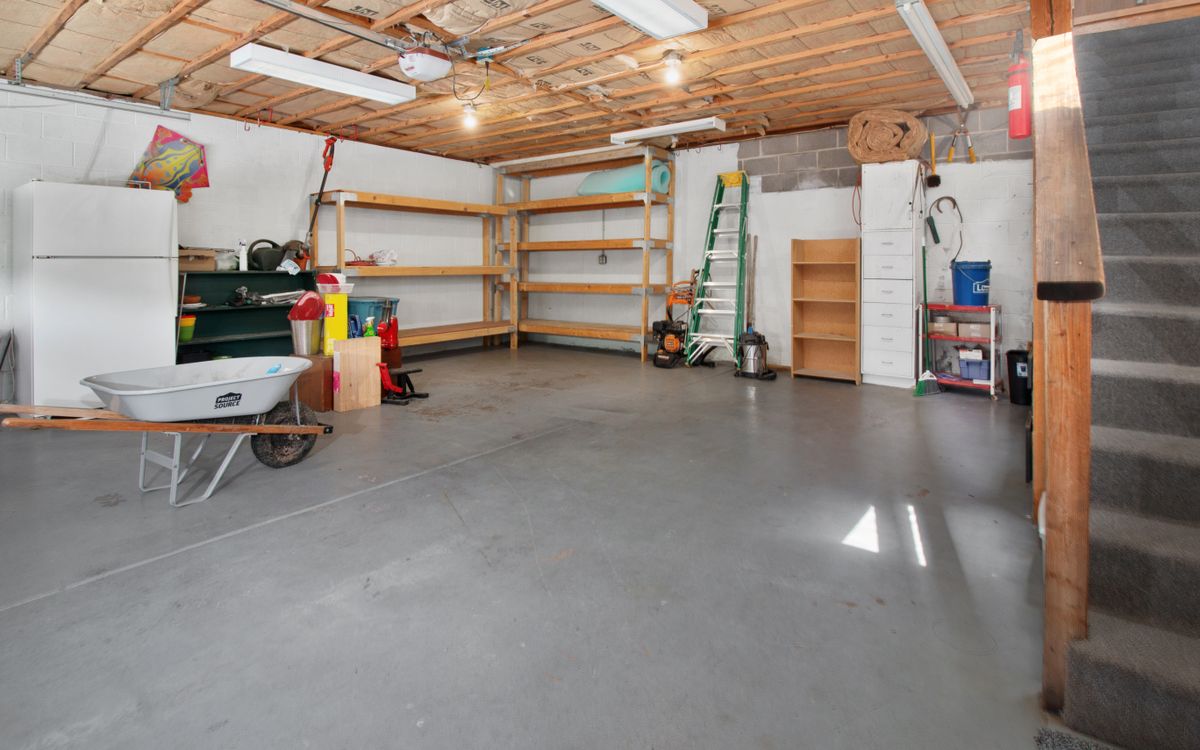
A utility room is the one room in the house where shelf height is decided by the things on the shelf rather than by the shelf. A broom stands about 55 inches. An upright vacuum stands about 45. A five-gallon bucket is 14.5 inches and a 40-pound litter pail is around 15. Those four numbers do not fit a single shelf spacing, which is why utility shelving built at one uniform height always ends up with a shelf of air above the short things and a pile of tall things on the floor.
The fix is to plan in bands. Three clear heights — 30, 18 and 12 inches — cover most of what a utility room holds, and a fourth zone, taller than all three, takes the items that will not go on a shelf at all.
Why height is an item problem
Shelf standards and brackets come in fixed increments: 12, 16 and 20 inch brackets are the common sizes, and the slots in a twin-slot standard repeat every inch. Item heights are not on any grid. A detergent jug is 11 to 13 inches depending on the size, a litter pail is about 15, a mop bucket with a wringer is close to 29.
If you install shelves at a fixed 16-inch spacing, the mismatch spreads through the room: the 11-inch jugs leave five inches of dead air, and the 29-inch bucket never fits anywhere. The band approach starts from the items and works outward, and it produces a wall where the gaps are different sizes on purpose.
The three bands and what belongs in each
Each band is a clear height — the distance between the top of one shelf and the underside of the next — not a shelf position.
| Band | Clear height | Items it takes | Examples |
|---|---|---|---|
| Tall | 30 in | 24 to 30 in standing | Mop bucket with wringer (about 29 in), two stacked 5-gal buckets (29 in), tall trash can, folding step stool |
| Middle | 18 in | 13 to 18 in | 40 lb litter pail (about 15 in), 150 oz detergent jug, stockpot, rice cooker, cleaning caddy |
| Low | 12 in | up to 12 in | Boxed goods, canned goods, paper products, light bulbs, spare filters, batteries |
The 30-inch band is the one people under-build. It looks excessive next to a 12-inch band, and then a mop bucket arrives and there is nowhere for it. Budget it once, at the bottom of the run where the weight is, and the rest of the wall can be fine-grained.
The 18-inch band is the workhorse. It takes every jug, pail and caddy in the room with two or three inches of lift clearance, which is what you need to get your fingers over the handle of something at the back.
The 12-inch band is for the contents of a cupboard that has outgrown the kitchen. Cans are 4 7/16 inches tall, a cereal box is around 12 inches, and paper goods compress, so 12 inches takes two tiers of most of it.
What the bands cannot hold
A 30-inch band will not take an upright vacuum. Neither will it take a broom, a folded ironing board or a step ladder. These are the items that make a utility room feel unmanageable, because they are taller than any shelf gap you would be willing to build across a whole wall.
They need a vertical slot instead: a bay at one end of the run with no shelf in it, floor to the top of the wall. The width of that slot is set by the widest of the group, usually the vacuum’s base at 12 to 13 inches, plus a few inches so the hose and cord are not jammed against the wall. Fifteen inches of width is a working figure; 18 is comfortable.
There is a second option, which is to start the shelving above the tall items rather than beside them. A vacuum of 45 inches needs the first shelf at 48 inches, and everything below that is open floor. That works under an 8-foot ceiling, but it turns the bottom four feet of wall into a parking bay and leaves room for two bands above it. It suits a narrow room and starves a room that needs volume.
The bottom shelf starts at 12 inches
New shelving usually gets installed as low as the brackets allow, which puts the bottom board an inch off the floor. That is the wrong instinct in a utility room.
Twelve inches of clear height below the bottom shelf buys three things. It lets a mop pass underneath, so the floor can be cleaned without unloading the wall. It keeps cardboard and paper off a concrete slab that wicks moisture, which is the difference between boxes that survive five years and boxes that sag in two. And it clears the baseboard and any skirting, so the shelf can sit flat against the wall instead of being packed out.
If the room has a floor drain, a utility sink or a water heater, twelve inches is also the difference between a flood and an inconvenience. Water finds the lowest box on the wall first.
The one adjustment is buckets. A five-gallon bucket is 14.5 inches tall, so twelve inches of clearance will not let it slide under. If that is where the buckets live, set the bottom shelf at 15 inches clear and accept the extra inch of lost wall above it.
Adding the bands up an 8-foot wall
A standard ceiling is 96 inches. Working from the floor with 12 inches of clearance, a 30-inch band, an 18-inch band and a 12-inch band, using three-quarter-inch shelf boards:
- bottom shelf surface: 12 in
- 30-inch band: next shelf at 42.75 in
- 18-inch band: next shelf at 61.5 in
- 12-inch band: top shelf at 74.25 in
That leaves 21.75 inches between the top shelf and the ceiling, which is more than a top shelf needs and more than most people plan for. Two options. Raise the whole stack, or add a fourth band: another 12-inch gap puts the top shelf at 87 inches, leaving 9 inches of clearance to the ceiling — enough to lift a bin lid off and no more.
On an 84-inch basement ceiling the arithmetic fails at the top. The same sequence ends at 74.25 inches with 9.75 inches to spare, which is too little for a lidded bin and too much to leave empty. Drop the top 12-inch band in that room and put the boxed goods in a closed cabinet instead.
The other number to check is span. Bands set the vertical gaps; brackets set the horizontal distance between supports, and a 12-inch board carrying cans will sag if that distance runs past about 32 inches. Keep brackets at 24 to 32 inches on centre and fix into studs at 16-inch centres, and put the heavy stock on the lowest band rather than the highest.
Where the water heater and the panel take precedence
Two things in a utility room overrule any shelf plan.
An electrical panel needs a clear working space in front of it: 30 inches wide, 36 inches deep and 6.5 feet high, measured from the floor. Nothing goes in that zone — no shelf, no bracket, no stack of paint. The 36 inches is measured outward from the panel face, and the 30 inches is measured across — wider than many panels, so a shelf tight against the panel’s side can still sit inside the zone.
A gas water heater needs the clearance printed on its own label, and the label varies by type. The mistake that recurs is a shelf of paint, solvents and cardboard directly above the flue, close enough to get warm. If the heater is in the room, leave the wall above and beside it clear and put the shelves on the other wall. A shelf 12 inches off the floor in front of a heater is also a place where things get stored and forgotten.
The third constraint is the utility sink. Rim height is usually 32 to 34 inches, and a shelf at that height above the sink is unusable — you cannot lean over it to reach the tap. Start the shelf at 60 inches above a sink, or put it on the wall beside it.
Depth, and the 12-inch rule
A utility shelf that is 16 inches deep holds no more than a 12-inch one for most of this room’s contents, because the back four inches are behind the mop bucket. Twelve inches of depth takes every item on the bands, and the bucket at 12 inches in diameter sits with its handle clear of the wall.
Sixteen inches earns its place in two cases: the tall zone, where a vacuum base plus hose needs 14 inches, and any shelf holding bulk paper goods or cat litter bought in cases. Everywhere else, depth past 12 inches is space you pay for and cannot reach. The arithmetic behind that is in the twelve-inch rule.
Depth also sets the bracket. A 16-inch shelf on 32-inch centres carrying cans needs a bracket rated for the span, not the cheapest L-bracket on the shelf. The load side of that question is set out in wall shelving load ratings.
What to measure before you drill
Measure the tallest item in each group with a tape, standing as it will stand on the shelf, and add two inches. The vacuum goes down with the handle collapsed, because that is how it will actually be stored. The bucket is measured with the wringer on, not off.
Then measure the wall, not the room. Shelf height is measured from the floor at the wall, and a garage or basement slab often falls a quarter inch in ten feet. Mark the heights at both ends of the run with a level line rather than measuring up from the floor at each bracket.
Finally, look at what is already on the wall. A switch at 48 inches, an outlet at 48, a dryer vent at 40 and a hose bib at 24 all sit inside the band you are about to build. A shelf that lands on a switch is a shelf you will move in a month, and the holes will still be there.