The height of an over-toilet shelf is not set by the ceiling, and it is not set by how tall you are. It is set by the tank lid, which has to come off, and by the two feet of space behind your shoulder blades that a shelf is not allowed to occupy while you are sitting down.
Almost every unit sold for this spot is dimensioned to fit a generic toilet in a generic bathroom, which is why so many of them end up with the bottom shelf sitting at shoulder height or bolted so low that the fill valve can never be reached again. Both failures come from the same missing step: measuring the fixture instead of the wall.
The tank lid is the part that has to come off
A toilet tank lid is a loose slab. It sits in a shallow recess on top of the tank and lifts straight up, and on most two-piece toilets it weighs 3 to 6 pounds. Nothing holds it down, which is the point: everything inside the tank is serviced through the opening it covers.
That makes the lid the first constraint on any shelf above it. The lid has to rise by its own thickness plus the depth of the recess before it clears, and then it has to travel forward and sideways to be set down. A shelf directly above the tank with 2 inches of gap does not give you that path. You can lift the lid an inch and no further, and the flapper you were going to replace stays where it is.
Four inches is the practical floor for the gap between the tank lid and the underside of the lowest fixed shelf. That is enough to break the lid free and walk it out at an angle. It is not enough to get a hand into the tank, so a shelf at 4 inches converts every repair into a shelf-removal job.
Ten to twelve inches is the figure most installers work to, and it is the one to aim for if the room allows it. At that height the shelf is clear of the lid, clear of the flush lever on the front of the tank, and high enough that you can reach the fill valve and the flapper with the lid resting on the tank at an angle.
The flush lever is the constraint people forget. On a front-mounted lever the handle sits 2 to 4 inches below the top of the tank and needs a couple of inches of swing. A shelf whose underside lands level with the lever looks fine in a photograph and is unusable in practice.
The tank dimensions you are actually working from
Four numbers describe the fixture, and all four vary by model.
| Measurement | Typical range | Why it matters |
|---|---|---|
| Floor to top of tank | 27–32 in | Sets the gap under the first shelf |
| Tank width at the top | 14–18 in | Sets the clear span between the rack’s uprights |
| Tank depth front to back | 6–8 in | Sets how far a shelf overhangs your back |
| Rim height | 15–17 in standard, 17–19 in comfort | Moves everything above it upward |
The heights are the ones that surprise people. A standard two-piece toilet puts the top of the tank somewhere between 27 and 32 inches above the floor, and a comfort-height model sits at the top of that range because the bowl is 2 inches taller. Two bathrooms with the same rack and the same ceiling can differ by 4 inches of usable clearance purely because of the fixture.
The retail listings show the consequence. A common three-tier freestanding unit is 23.6 inches wide, 9.4 inches deep and 68.2 inches tall, and the maker states roughly 35.5 inches from the floor to the first shelf. Put that over a toilet whose tank top is at 29.5 inches and you have 6 inches of clearance: enough to lift the lid, not enough to work. That is why the lowest tier on units like this is usually a wire rail rather than a board. It is a stabiliser, not a shelf, and loading it with bottles is what makes these racks feel useless.
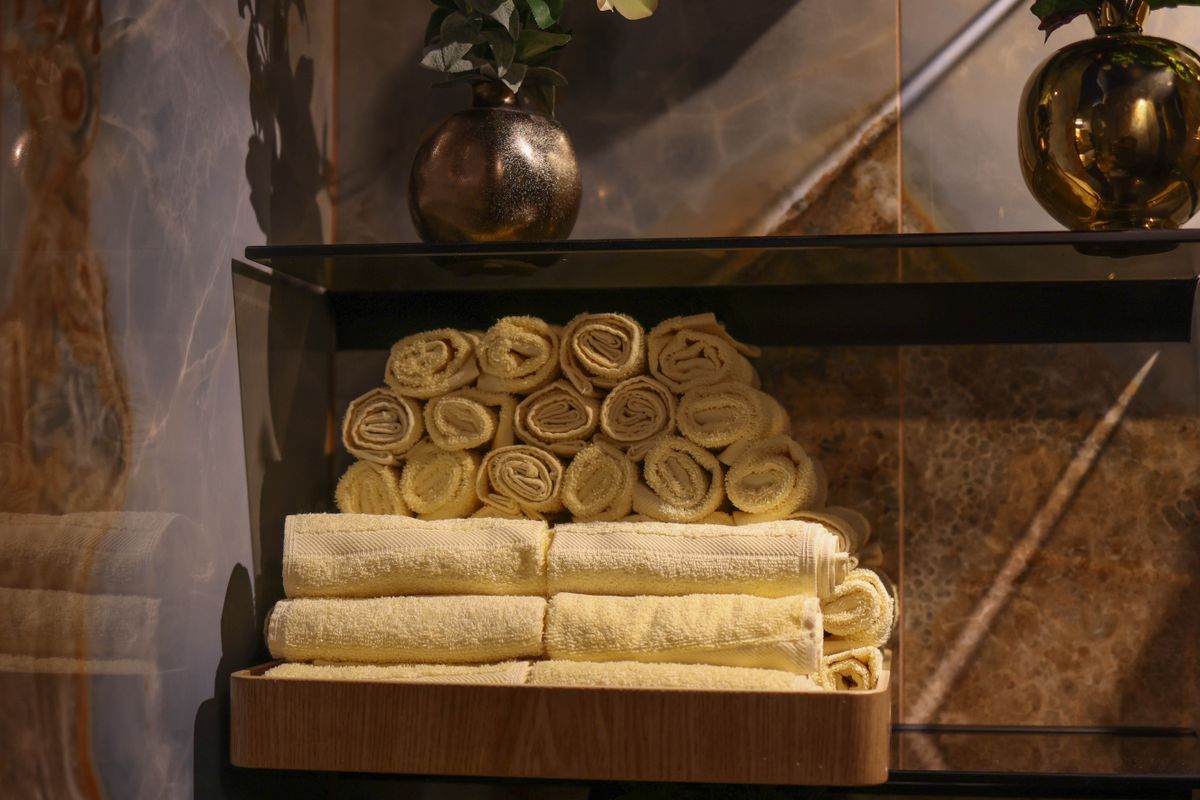
Seated clearance is a shoulder problem, not a head problem
Everyone checks the head. The head is rarely the issue.
An adult sitting on a 16-inch rim has the top of the head at roughly 50 inches above the floor and the top of the shoulder at roughly 38 inches. A lowest shelf sitting between 35 and 39 inches, which is exactly where the freestanding units put it, is at shoulder height rather than head height. You will not bump your head on it. You will lean back into it.
The saving grace is that the shelf sits behind you rather than over you, because the rack stands against the wall and the toilet projects forward from it. The catch is depth. A rack 9 to 10 inches deep placed over a tank 6 to 8 inches deep overhangs the front of the tank by 1.5 to 3.5 inches, and that overhang is the part your shoulder blades find.
The rule that follows is simple to apply and easy to check with a chair. Sit on the closed lid, lean back until your shoulders are against the wall, and note where the back of your shoulder sits relative to the front face of the tank. If the shelf’s front edge would be forward of that point and its underside is below about 46 inches, the shelf is in your way.
This is also why wall-mounted shelves above the toilet work better in small rooms than tall freestanding racks. A wall-mounted shelf 6 inches deep sits entirely above the tank, so there is no overhang and nothing at shoulder height except a shelf you have chosen to put there.
Legs, baseboard and the shutoff valve
A freestanding rack has four points of contact with the floor, and three things in the first 8 inches of the wall that interfere with them.
Baseboard. Standard baseboard is 3.5 to 5.5 inches tall and projects roughly 0.5 to 0.75 inch from the wall. The rack’s back rail cannot pass through it, so it rests on the face of the baseboard and the whole unit moves forward by that amount. On a 9.4-inch-deep rack, three-quarters of an inch is 8 percent of the depth, which is the difference between a shelf behind your back and a shelf against it.
The shutoff valve. The water supply stop sits low, usually 6 to 8 inches above the floor and a few inches to one side of the bowl, with a flexible supply line running up to the tank. A rack’s bottom stabiliser bar occupies exactly that height. This is why the better units publish an adjustment range for the bottom bar rather than a fixed position; the unit above offers 2.8 inches of travel, which is enough to clear a valve body on most installations but not all of them.
The bowl base and flange caps. The porcelain base flares to about 9 to 10 inches wide where it meets the floor, and the closet bolt caps project another half inch or so. A rack 23 to 26 inches wide puts its legs 6 to 8 inches outboard of the bowl on each side, which clears the porcelain but can leave a foot sitting on a bolt cap. A rack that rocks on a bolt cap will rock forever.
The fix for all three is the same measurement pass: floor to the top of the baseboard, baseboard projection, valve height and side, and the widest point of the bowl base at the floor. If a foot cannot land flat within 4 inches of the wall, the unit will need shimming, and a shimmed rack over a toilet is a rack that eventually tips.
Eight to ten inches of depth, against a six to eight inch tank
Depth is the specification that separates a rack you keep from a rack you give away, and it is the one least often printed clearly.
Wall-mounted shelves for this spot typically run 5.9 to 6.1 inches deep, because they only have to sit above the tank rather than around it. Freestanding racks run 8 to 10 inches, because the uprights have to stand behind the tank and the shelves have to span forward over it.
Neither number is wrong. They answer different questions. A 6-inch wall shelf gives you somewhere to put two folded towels and a bottle, with no overhang and no shoulder conflict, but it cannot hold a basket of anything heavy and it needs a wall you can drill. A 10-inch freestanding rack gives you three tiers and 40 percent more shelf area, at the cost of 4 inches of floor depth you may not have in front of the toilet.
The mistake is buying the deep unit for the shelf area and then discovering that the extra depth is entirely in front of the tank, at shoulder height, where you cannot use it anyway.
Wall-mounted or freestanding: the anchor decides the load
The load on an over-toilet shelf is smaller than people expect and the anchor matters more than the shelf.
A folded bath towel weighs 1.5 to 2 pounds. A 24-ounce bottle of shampoo weighs about 1.6 pounds when full. A shelf holding two towels, four bottles and a basket of spare rolls is carrying somewhere around 15 pounds, spread across a shelf 24 inches wide and 6 inches deep.
That is not a demanding load for a steel bracket. It is a demanding load for two drywall anchors in a wall you have not inspected. The rating printed on an anchor package assumes clean, sound drywall of the thickness stated and a hole drilled to the size stated. A 1950s wall with a skim coat, a layer of tile adhesive, or a patch from an old mirror is none of those things.
Three rules follow. Anchor into at least one stud wherever the layout allows, and use two anchors on the other end rather than one. Keep the heaviest items on the lowest tier, because a tall rack is a lever and the top shelf has the longest arm. And use the anti-tip strap that ships with almost every freestanding unit; a 68-inch rack loaded at the top with 15 pounds will go over if someone leans on it.
The five measurements to take before you order
Take these with a tape and write them down, because every product page will ask you for at least three of them.
- Floor to the top of the tank lid, at the highest point. On a comfort-height toilet this is 31 to 33 inches, not 29.
- Tank depth front to back, measured across the top of the tank where the lid sits.
- Tank width at its widest, which is usually the lid rather than the tank body.
- Baseboard height and its projection from the wall face.
- Floor to ceiling directly above the tank, since freestanding units run 60 to 68 inches and a low ceiling or a soffit will stop one going in.
Then do the subtraction. Ceiling height minus unit height tells you whether it fits at all. Tank top height subtracted from the first shelf height tells you whether you can service the toilet. Baseboard projection added to the unit’s depth tells you how far into the room it will actually stand.
If the gap under the first shelf comes out under 4 inches, the unit is the wrong unit, no matter how good it looks. If it comes out between 4 and 10 inches, you can live with it, but plan on emptying a shelf every time the toilet needs attention.
For the storage that ends up beside the toilet rather than above it, the constraints are different: storing around a bathroom trap covers the awkward space under a sink, and what a bathroom wall hook can hold covers the vertical version of the same question. If the rack is going into a linen closet instead, start with the depth a linen shelf needs.