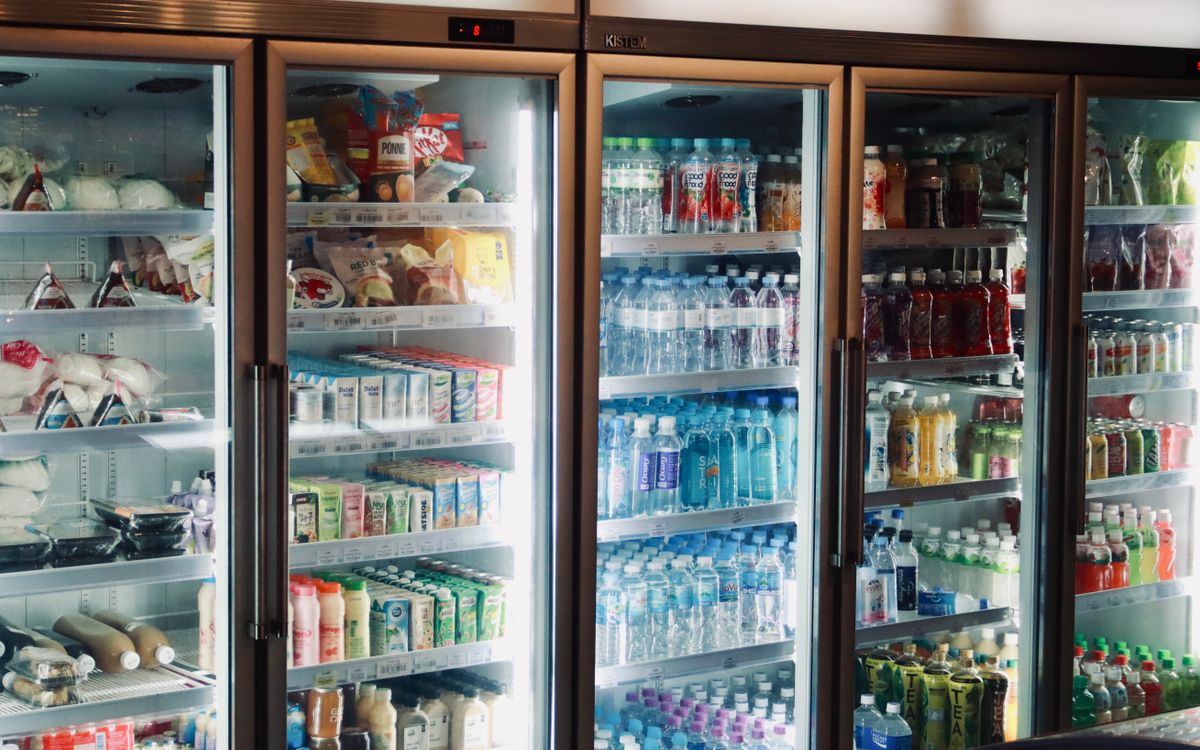
A refrigerator shelf is a bad piece of storage by design. It is 15 to 17 inches deep, it is lit from the front, and everything small slides to the back where the light does not reach and the cold air comes in. The appeal of clear bins is that they turn that shelf into a set of shallow drawers you can pull forward.
That is a real gain, and it is smaller than the marketing suggests. A bin does not add capacity. It occupies the same shelf, it takes up volume with its own walls, and if it sits in the wrong place it interrupts the one thing a fridge cannot do without, which is air movement.
This piece compares three bins that are widely sold for this job and works from the numbers that decide whether they help: footprint against shelf depth, height against the gap above, and how the base behaves when you pull it.
What a fridge bin can and cannot fix
A bin fixes three things. It keeps small items from migrating to the back. It lets you lift a whole category out at once, which is what makes condiments and yogurt usable in a crowded fridge. And it makes the shelf’s contents legible from standing height, because a group of items in a rectangle reads faster than the same items loose.
It cannot fix a fridge that is too full. A bin’s walls take volume, and its footprint is fixed, so a shelf that was 90 percent full becomes 100 percent full with less of it visible. It also cannot make anything colder. In a frost-free refrigerator the cold comes from air moved through channels, and the temperature at any point on a shelf depends on how close it is to the supply vent and how much is stacked in the way.
The third limit is the one people discover late: a bin that fills the shelf front to back leaves nowhere for air to pass, and the shelf stops behaving as one temperature. The rear, close to the supply vent, runs colder than the front, which is how lettuce freezes at the back of a shelf while the milk at the front of the same shelf sours early.
Airflow is the constraint nobody measures
Open a refrigerator and look at the back wall. There is a panel with slots or a gap at the top and bottom of the compartment, and that is where cold air enters and returns. The exact layout differs by model, but the principle does not: air has to get from the vent to the food and back.
Put a solid-walled bin against that panel and you have built a dam. The effect is not dramatic and it is not instant, but it is real, and it shows up first in the items that are most sensitive to a few degrees: leafy greens, herbs, milk at the back of the top shelf.
Three habits keep the airflow without giving up the bin:
- Leave 1 to 2 inches between the back of the bin and the rear wall. On most shelves this is the difference between a bin that works and one that blocks the return.
- Leave a gap between bins rather than butting them together across the full width.
- Do not stack bins to the underside of the shelf above. A 1-inch gap at the top of the stack keeps a slow convection path open and stops the top bin acting as a lid for the shelf.
The other airflow problem is inside the bin. A sealed or near-sealed container of produce traps ethylene, the gas that ripens and then spoils fruit and vegetables, and traps the moisture that comes off them. An open bin with a paper towel in the bottom does better for produce than a lidded one, which is why none of the three bins here ships with a lid.

The shortlist
Three bins, three different jobs, and only one of them is a system.
OXO Good Grips Fridge Organization Bin
The low-profile option. The large size measures 14.8 × 8 × 3 inches and the narrow one 14.8 × 5.75 × 3 inches, so a pair of the large ones fills a 16-inch width of shelf. There is also a 10.75-inch length for shallower shelves.
Three inches of height is the whole point. In a fridge with 8 inches between shelves, a 3-inch bin leaves 5 inches of clearance above it, which means you can stack a second bin, or put jars on top, or simply see over the bin to the shelf behind. A 6-inch bin in the same space forces you to choose between the bin and everything above it.
The base is smooth and the handles are moulded into the ends, so the bin slides forward on a glass shelf the way a drawer would. That is the feature that changes daily use: you pull the bin out, take what you need, push it back, and nothing at the back of the shelf has to be excavated.
What it does not have is a lid, feet or any stackable geometry. A second bin placed on top of the first sits on the rim and can shift, and nothing keeps a bin from sliding if the fridge is levelled badly. Both are fixable with liner and care rather than with money.
The 14.8-inch length is worth checking against your shelf. On a 15-inch shelf it leaves almost no gap at the back, and the rear vent is usually exactly there.
iDesign Linus Deep Kitchen Storage Bin
The tall option, and the only one of the three that solves the upright problem for vegetables. It measures 12 × 8 × 7.75 inches, which is deep enough for a bunch of celery, a bag of carrots standing up, quart containers, or the assorted jars that are too tall for a 3-inch bin and too unstable to leave loose.
The smaller footprint is the trade. At 12 inches long it leaves 3 to 5 inches of shelf depth behind it on a typical fridge shelf, and that gap is exactly what the airflow needs. In a fridge where the rear panel is crowded, this is the bin that can sit against the wall without doing damage.
It is open-topped with built-in handles and made from clear BPA-free plastic. There is no lid, no divider and no published load figure. The 7.75-inch height is the number to measure first: plenty of fridges have 7 to 8 inches between shelves, and a 7.75-inch bin in a 7-inch gap simply does not go in.
Sorbus Fridge Bins and Freezer Bins
The set, and the only one of the three that tries to organise a whole shelf rather than a category. Six pieces: two wide bins at 14.5 × 8.5 × 4 inches, two narrow bins at 14.75 × 4.25 × 4 inches, a can dispenser at 13.25 × 5.5 × 4 inches, and an egg holder at 14.5 × 4.37 × 3.12 inches with 14 slots.
Buying the set is the argument. Two wide bins side by side need 29 inches of shelf width, which is wider than most fridge shelves, so in practice the set gets distributed: wide bins on the main shelf, narrow ones on a door shelf or in a second row, can dispenser wherever the bottles are. That is more useful than a matched wall of identical bins, because a fridge has more kinds of small item than a pantry does.
All six are BPA-free plastic and hand wash only, which the maker states plainly. Four inches of height is a workable middle: tall enough for a pint of berries and a stack of yogurt, short enough to leave clearance above in most fridges.
The weakness is the fixed mix. If your fridge needs four wide bins and nothing else, the set sells you two narrow ones and an egg tray you will not use, and the spare pieces end up in a cupboard.
Drawer geometry: what slides, what jams
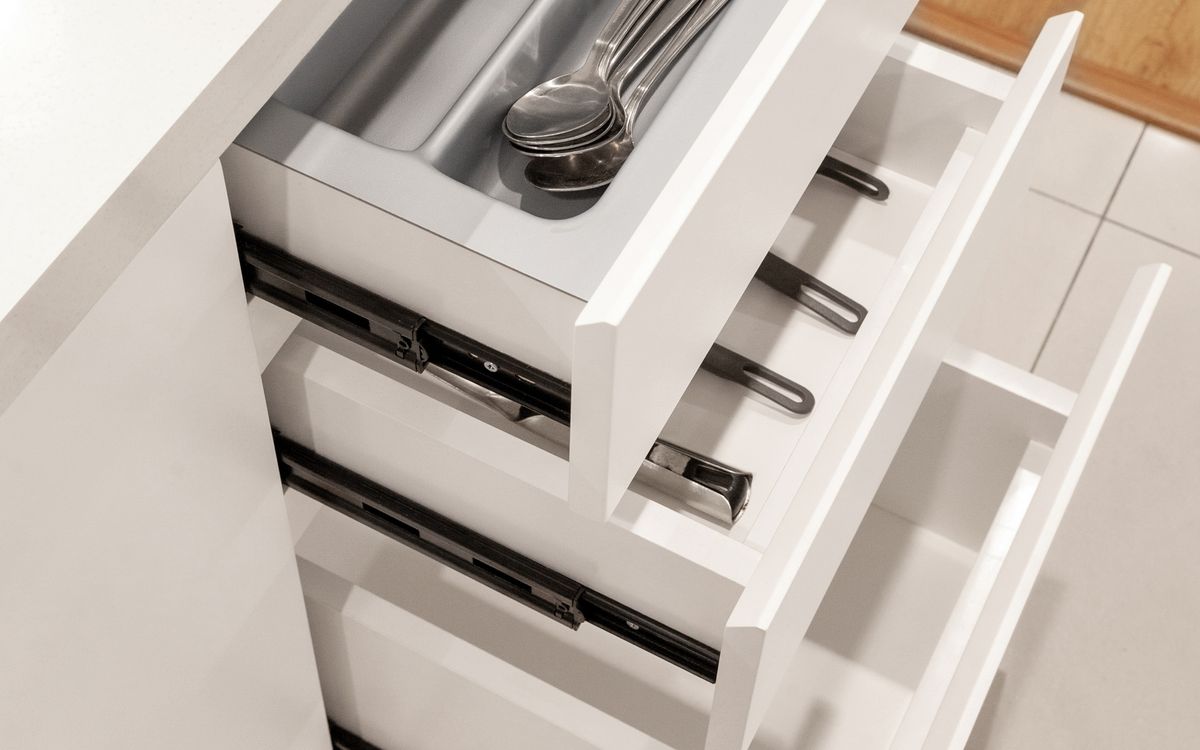
None of these bins runs on a slide. There is no rail, no bearing, no stop. The bin slides on the shelf, and the quality of that movement depends on three things: the base, the weight, and the gap at the sides.
A smooth base on a glass shelf slides well when the bin is light and badly when it is loaded with bottles. A textured or footed base grips, which is better for stability and worse for pulling. The moulded handle matters more than it looks: a bin with a recessed grip at each end can be pulled with two fingers, while a plain-walled bin has to be gripped by the rim, which tips it.
The jam is almost always lateral. A bin cut to the exact interior width of the fridge has no room to skew, and the moment it goes in slightly off-square it wedges. Leave half an inch at each side, or use two narrower bins instead of one wide one. The same applies to height: a bin that clears the shelf above by a quarter inch will scrape as soon as it is loaded and the base flexes.
If a bin does slide too freely, a strip of non-slip liner under it fixes the problem without adding measurable height. Cut it an inch smaller than the base so the liner does not curl up the sides and lift the bin.
Stacking and the volume you lose
Only one of these three is designed to stack, and even that one stacks loosely. The rest are open-topped, which means a second bin placed on top rests on the rim and relies on friction.
The arithmetic of stacking is unforgiving. Two bins of 3 inches need 6 inches plus a gap, so 7 inches of clear height. Two bins of 4 inches need 9. A fridge with 8 inches between shelves takes one stack of the 3-inch bins or none of the 4-inch ones. And a stack that reaches the shelf above closes the airflow path at exactly the point where the cold air wants to move.
| Clear gap above the shelf | What actually fits |
|---|---|
| 5 to 6 in | One 3 in bin, nothing above it |
| 7 to 8 in | One 3 in bin plus a second, or one 4 in bin with room to reach in |
| 9 to 10 in | Two 4 in bins, or one 7.75 in deep bin with a finger’s clearance |
| 11 in and over | A stack plus a shelf of jars above it |
The other loss is the volume the walls take. A 14.8 × 8 × 3 inch bin has an outside envelope of 355 cubic inches, which is just over 6 quarts if the walls were vertical and square. They are not: moulded bins draft inward toward the base and the walls have thickness, so the usable volume is meaningfully less. No manufacturer in this comparison publishes an interior figure, which is why these bins are better compared by footprint than by quarts.
Capacity: what the footprint actually holds
The useful way to size a bin is by what you put in it, not by volume. A few numbers that hold across most fridges:
A standard yogurt cup is about 3 inches across and 3 inches tall, so a 3-inch bin takes them lying on their side and a 4-inch bin takes them upright. A 12-ounce can is 4.8 inches tall and will not stand in either, which is why the Sorbus set includes a can dispenser as a separate piece. A 1-quart deli container is 4.5 inches across, so an 8-inch-wide bin takes one row of them and nothing beside it.
For produce, depth matters more than volume. A 3-inch bin holds one layer of peppers, or a head of lettuce beside a bag of carrots, and anything that has to pile up bruises under its own weight. Filling a bin to the top also removes the air gap that keeps the middle of the pile from sweating.
For bottles, height decides everything, and nothing here is tall enough. A wine bottle is 12 inches, a beer bottle 9, a standard condiment bottle 8 to 9, and the tallest bin in this comparison stops at 7.75 inches outside. So a bottle goes in on its side, where the bin does a useful job of stopping it rolling, and the door stays the right place for anything you want to keep upright.
Cold, cracking and the dishwasher question
All three bins are made for refrigerated use, and all three are made from rigid clear plastic that gets less forgiving as it gets colder. None of them publishes a temperature rating, so the coldest part of a freezer is an assumption rather than a specification. The failure mode to expect is a crack at a corner or a handle after a drop on a hard floor, not a slow degradation in the cold.
The dishwasher is the real risk. Heat is what warps this class of plastic, and the top rack of a dishwasher runs hot enough to distort a thin-walled bin. Sorbus states hand wash only. The OXO listing does not state dishwasher safety for these bins. iDesign says mild soap and water. Treat all three as hand wash and the bins will last years; run them through a hot cycle and the bases will stop sitting flat.
Cold also affects what you put in them. A bin pulled from a 35°F fridge and filled with room-temperature groceries will sweat on the outside, and that condensation drips onto the shelf below. Setting the bin on the counter for a minute before loading it avoids most of it.
Which bin for which fridge
For a fridge with 8 inches of shelf gap and a shelf that disappears at the back, the OXO Good Grips Fridge Organization Bin is the one to start with. Three inches of height is the least expensive thing you can do to a shelf, and the 14.8-inch length is enough to hold a category without walling off the vent, provided you leave the gap at the rear.
For celery, quart containers and the awkward tall items that currently live loose on a shelf, the iDesign Linus Deep Kitchen Storage Bin is the only one here with the height for the job, and its 12-inch length buys back the rear clearance that the OXO gives up.
For a fridge that needs to be set up once rather than solved piece by piece, the Sorbus Fridge Bins and Freezer Bins six-piece set covers the most kinds of small item for the money, at the cost of two pieces you may not need.
Whichever you choose, measure two things before ordering: the clear gap between shelves, and the depth of the shelf from the front edge to the vent panel. If the first number is under 7 inches, buy the 3-inch bins and stop there. If the second is under 15 inches, buy the 12-inch bins and let the airflow have the rest. For the arithmetic of what a container really holds, storage capacity math applies the same method to pantry containers, and the pantry container systems compared covers the lidded version of this problem. If the bins are headed for a garage shelf instead of a fridge, the clear bins that survive cold are built to a different set of rules.