Spices do not fail all at once. A jar of cumin that has spent two years beside a gas cooktop does not turn bad on a particular Tuesday; it goes quiet, a little at a time, until a teaspoon of it does nothing to a pot of beans. The mechanism is evaporation and oxidation of the volatile oils that carry the aroma, and both run faster when the jar is warm.
That makes spice storage a heat problem before it is a rack problem. The useful measurement is not how many jars a rack holds but how far the rack sits from the burners, and in most kitchens the rack on the counter turns out to be too close while the cabinet above the range sits at exactly the 30 inches the building codes allow.
What heat actually does to a ground spice
A whole seed keeps its aromatic oils inside intact cells. Grinding opens those cells and multiplies the surface area exposed to air, which is why the published figures differ so sharply by form: guidance from the USDA’s FoodKeeper programme and from university extension services puts ground spices at 6 to 12 months once opened, and whole spices at two to four years.
Three things accelerate that clock. Oxygen reacts with the oils. Light drives photo-oxidation, which shows first in the pigments, so paprika goes from red to brick and turmeric from yellow to sand. Heat raises the rate of both reactions and also drives the oils out of the spice and into the headspace of the jar, where they are lost the moment the lid comes off.
Moisture is the fourth, and the one that produces visible failure rather than quiet failure: clumping. It is also why extension guidance says not to keep spices in the refrigerator, where humidity and the open-close cycle do more harm than the cool does good.
There is no failure temperature, which is the useful part
You will find numbers quoted as thresholds — spices dead above 75°F, and so on — and none of them is a measured cliff. There is no temperature at which a spice stops working, the way there is a temperature at which a plastic softens. There is a rate, and the rate rises smoothly with temperature.
Published storage guidance usually draws the top of the good range near 70°F (21°C). The rough rule from food chemistry is that reaction rates double for every 18°F (10°C) of warmth. That is a rule of thumb rather than a measurement of any particular spice, but it is the right shape for this problem: a cabinet sitting at 88°F runs flavour loss roughly twice as fast as a 70°F pantry, and a counter rack at 95°F about two and a half times as fast.
That is the number worth carrying around. Not a death temperature, a multiplier. A jar that would have been good for twelve months at 70°F is good for about six at 88°F. Since 6 to 12 months is already the guidance for ground spice in a good pantry, the hot zone does not shorten a long life. It removes the margin.
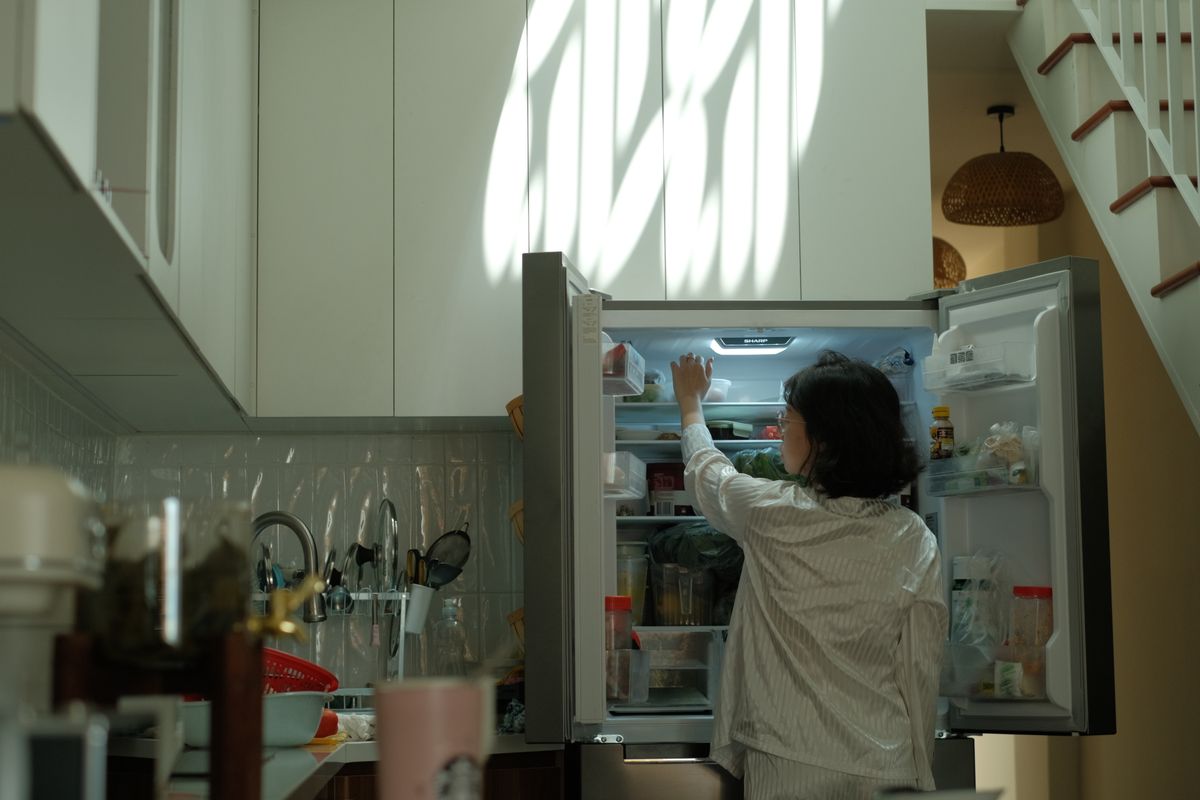
How hot is the cabinet above the stove?
Hotter than the rest of the kitchen, and nobody can tell you how much hotter without measuring, because it depends on the burner, the hood, the distance from the surface and whether the cabinet has a door at all.
What can be said is the geometry. The residential model codes require at least 30 inches between a cooking surface and unprotected combustible cabinets above it, so the underside of that cabinet sits 30 inches from a gas flame at minimum, and often exactly 30 because builders build to the minimum. Thirty inches is close enough for a plume of hot air and steam to reach the door and the shelf behind it. A microwave mounted over the range adds a second heat source and a fan that pushes the plume sideways into the cabinets on either side.
The measurement is easy and almost nobody does it. Put an inexpensive oven thermometer on the shelf where the spices actually sit, shut the door, cook three normal dinners, and read the maximum. A cabinet that peaks above 85°F is a hot cabinet. Above 95°F it is an oven with a door, and the spices in it are on a four-month cycle at best, whatever the label says.
The counter rack is the worst of the three
A counter rack has every disadvantage at once. It is the closest of any option to the burners, it takes direct light from a window for part of the day, it collects a film of cooking grease that is miserable to remove from glass, and it sits in the path of steam from a pasta pot. It also consumes the one surface in the kitchen that has to absorb everything else.
The grease point is underrated. A jar that lives on an open rack for a year has a sticky exterior, and a sticky jar gets handled constantly, which means the spice inside is opened and closed more often than the same spice in a drawer. Every opening exchanges the headspace with room air.
If a counter rack is the only option — a rental with no drawer space, for instance — put it at the far end of the run from the range rather than between the range and the sink, and accept that ground spices on it are on a six-month replacement cycle. Twenty-four inches (60 cm) from the burner edge is a reasonable minimum. Further is better, and no rack is worth putting inside the steam plume to keep it visible.
A drawer is the best default, if the drawer is deep enough
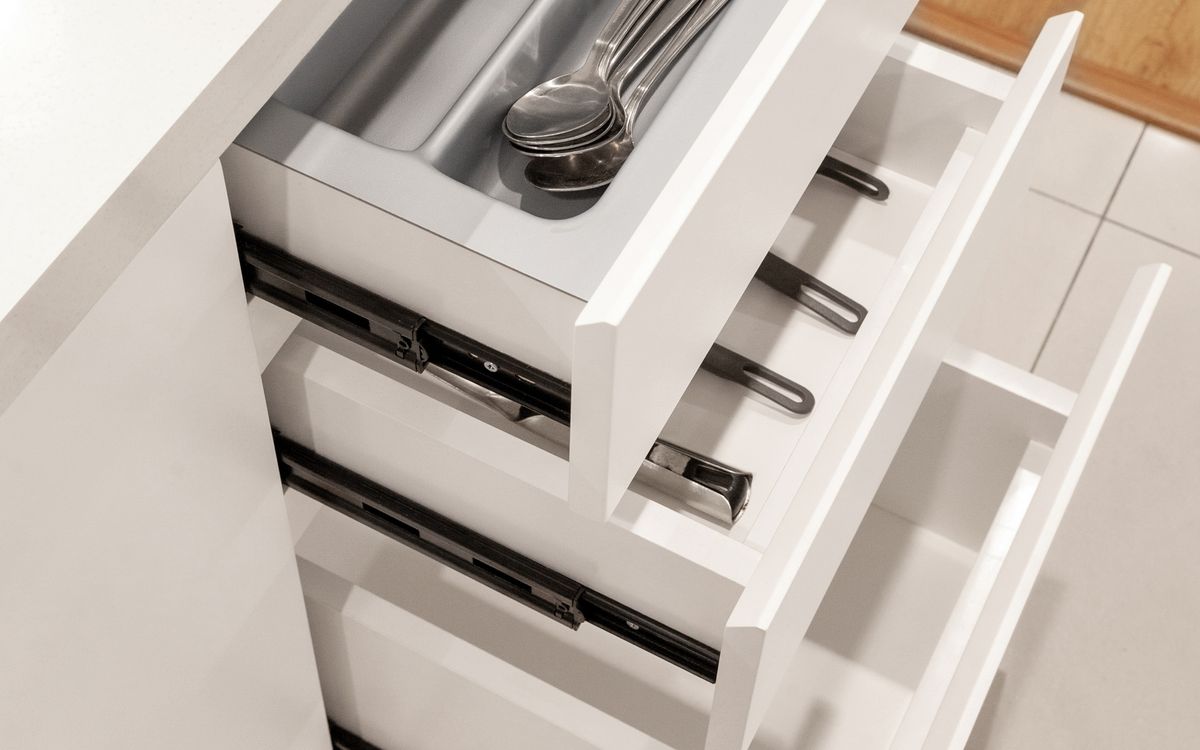
A drawer is dark, it sits at the cool bottom of the cabinet stack, and it removes the jar from the steam entirely. The constraint is height. The shallow drawer at the top of a base cabinet is commonly about 3 inches deep inside, and a supermarket spice jar is roughly 4 to 4.5 inches tall, so jars either lie on their sides, which invites leaks through a shaker top, or the drawer has to be a deeper one.
The measurements to take before buying any insert:
- Interior height of the drawer box, not the height of the drawer front.
- Interior width and depth, minus the runner hardware at each side.
- The diameter of your widest jar, usually 1.75 to 2.25 inches for a standard bottle and more for anything decanted at home.
- How far the drawer opens before it hits the counter overhang.
A pull-down in-cabinet rack solves the reach problem in an upper cabinet but not the heat problem, because it sits where the cabinet sits. The YouCopia SpiceStack is listed at 11 inches deep, 8.1 inches wide and 8.3 inches high, holding 18 full-size bottles, and those three numbers are the ones to check against a shelf before ordering. The bottle count is the least useful figure on the page.
Door racks: two inches of depth and a hinge that has to carry it
An inside-door rack is the most space-efficient option in a small kitchen, because the door panel is otherwise dead space. It is also the option with the tightest dimensional limit: most door racks are 1.5 to 2.5 inches deep, which fits a standard bottle and nothing wider.
Two things fail. The first is the hinge. Twenty-four glass jars at around 2 ounces each is 3 pounds of spice plus the weight of the rack, hanging on a door that was engineered to carry a panel. Adjustable hinges cope for a while, then the door starts to sag and stops closing flush. The second is interference: a rack mounted on the hinge side collides with the cabinet frame or the shelf edge as the door swings, which is why most door racks are designed for the handle side only.
On heat, a door rack is marginally better than a shelf at the front of the same cabinet, because when the door is shut the jars sit behind the panel. Marginal is the right word. It is still the same cabinet, at the same distance from the same burners.
Where the bulk jar should live
Most kitchens have two spice populations and treat them as one. The working set is a dozen jars used weekly. The bulk set is the bag of cumin, the one-pound bag of paprika, the chile powder bought for a single recipe and never finished.
The working set belongs wherever you can reach it in one motion with a pan already on the heat. The bulk set should be split: decant two or three weeks’ worth into a small jar and keep the rest sealed, labelled and out of the hot zone, in a cool cupboard on the far side of the kitchen or in the freezer if it is whole.
The freezer is genuinely useful for whole spices and seeds and less so for ground, and the handling matters more than the temperature. A jar taken out of the freezer and opened while still cold condenses moisture onto the spice, which is the exact failure the freezer was meant to prevent. Let it come to room temperature sealed, then open it.
A layout that survives a small kitchen
The sequence that works in a small kitchen is unglamorous. Move the daily jars out of the 24 inches beside the range. Put them in a drawer if the drawer is deep enough, or in a pull-down rack in an upper cabinet if it is not. Keep the counter clear. Keep bulk stock cool and opaque, and refill the small jars rather than dipping into the bag at the stove.
None of that requires a system. It requires a thermometer, a tape measure, and the decision that the prettiest rack in the shop is not allowed to sit next to the burners.
If the drawer you have is too shallow, the workaround is the same one that applies to any deep cabinet: split the depth into two zones instead of filling it to the front. For the corner where the oils and vinegars end up, the case for a lazy Susan over a pull-out is mostly about how far you are willing to reach. And if the spice rack is one symptom of a wider problem, the storage mistakes that cost space covers the ones that repeat in every kitchen.