Sideboard depth looks like a styling decision until you try to put a charger plate in one. Three depths dominate the market — 14, 16 and 18 inches — and the difference between them is not proportional to the number. Each one crosses a specific threshold in dinnerware, and once you know which threshold, the choice stops being about taste.
Start with the inside. A sideboard sold as 16 inches deep gives you about 14.5 inches of usable depth, because the back panel and the door come out of the outside figure. Every number below is an interior number, and the arithmetic is the same one that governs pantry shelf depth.
Why sideboards are 14, 16 or 18 inches deep
Dining sideboards settled at 18 inches because that is the depth at which a whole service fits without a second decision: a charger lying flat, a 16-inch platter lying flat, and a stack of bowls behind a closed door. Twelve inches would do for plates alone. Eighteen does it for everything that comes to the table.
The 14-inch form comes from the other direction: hallways and console tables, where the constraint is the walkway rather than the plate. It is the depth of a media console and the depth that leaves a usable passage in a narrow room.
Sixteen inches is the compromise that appears most often in apartment-scale furniture. It is deep enough for a plate flat and not deep enough for a plate rack plus a stack, which makes it the depth that decides the most purchases badly.
Subtract 0.5 to 0.75 inch for the back panel and 0.75 inch for a door, and the three nominals become about 12.5, 14.5 and 16.5 inches of usable depth. Those are the numbers that have to clear a plate.
What 14 inches holds
Twelve and a half inches inside is enough for a 10.5-inch dinner plate lying flat, with 2 inches to spare. Eight plates stacked at roughly half an inch each come to 4 inches of height, so a 14-inch sideboard can hold a full eight-place setting in one stack per shelf.
It is also the depth limit for everything larger. A 13-inch charger does not go in flat, because 13 inches of plate plus a finger’s clearance is more than 12.5. A 14-inch platter does not go in flat either. Two rows of plates front to back need about 21 inches and are not possible at any of these depths.
What a 14-inch sideboard does well: stacked dinner plates, salad plates, cereal bowls, cutlery in a drawer, napkins, and a single row of mugs. What it does not do: chargers, a turkey platter, a soup tureen, a cake stand with a 12-inch base, or a stack of large serving bowls.
What 16 inches adds
Fourteen and a half inches inside buys exactly one thing: the charger plate. A 13-inch charger lies flat with about an inch and a half to spare, and that margin is the difference between a sideboard that can hold a formal setting and one that cannot.
It also enables the two-zone layout that makes a sideboard useful. A plate rack against the back panel occupies about 10.5 inches of depth for dinner plates, which leaves 4 inches in front — enough for a row of mugs at 3.5 inches across, or a stack of small bowls. That arrangement is not possible at 12.5 inches of interior depth, where a plate rack leaves 2 inches and nothing fits in it.
Sixteen inches still fails on the largest items. A 16-inch platter needs 16 inches plus clearance, and a tureen needs 12 inches of diameter plus the lid. Both want the next size up.
What 18 inches is actually for
Sixteen and a half inches inside is the depth at which dinnerware stops being a constraint. A 13-inch charger stands upright with 3 inches left in front for a row of cups. A 16-inch platter lies flat, just. A 12-inch tureen fits with the lid on.
This is also the depth that takes linen. A folded tablecloth for a 60-inch table is roughly 16 × 11 × 4 inches when folded properly, and it fits a 16.5-inch interior without being compressed into a shape that creases along the wrong line.
The cost is the footprint. An 18-inch sideboard with its door open needs about 38 inches of floor, which is fine in a dining room and wrong in a hallway. In a 36-inch hallway, an 18-inch cabinet leaves 18 inches of passage, and 18 inches is not a walkway; it is a squeeze past a wall.
Plates standing up: the clearance that decides it
Upright storage is a different calculation, and it is where most sideboard purchases go wrong, because it depends on height rather than depth.
A plate standing in a rack needs clear height equal to its diameter, plus roughly half an inch for the rack’s lip and half an inch for your fingers. A 10.5-inch dinner plate therefore needs about 11.5 inches of clear height. A 13-inch charger needs about 14 inches. Depth used is the plate’s diameter, 10.5 or 13 inches, because the plate leans back only a few degrees.
Now compare that with the three cabinets. A 14-inch sideboard has 12.5 inches of depth, enough for a 10.5-inch plate standing, but only if the shelf gap is at least 11.5 inches. A 16-inch sideboard has the depth for a charger but usually not the height, because the shelf sits at mid-height in a 30-inch carcass and each of the two gaps comes out around 13 inches. An 18-inch sideboard with a shelf gap of 14 inches is the first one that takes a charger upright.
This is why a deeper sideboard does not always solve a plate problem. If the plates are already standing and the door will not shut, measure the shelf gap first and the depth second. The vertical clearance you gain by moving a shelf is free; the depth you gain by buying a new sideboard is not.
Bowls, platters and the stack that tips
Bowls are the other item that punishes a shallow assumption. A cereal bowl is 6 to 6.5 inches across and 2.5 to 3 inches tall, and bowls nest at about 1.25 inches each, so six of them come to roughly 9 inches of stack height. That fits most sideboard gaps, but a 9-inch pasta bowl is 2 inches tall on its own and will not go under an 8-inch gap.
Platters behave counter-intuitively. A 16-inch platter stored upright needs 16 inches of height and only 6 to 8 inches of depth, because it leans against the back at 20 to 25 degrees. So a tall sideboard with a 16-inch gap stores platters on a 14-inch depth, while a deep sideboard with a 12-inch gap cannot store them at all. Depth is the wrong measurement for the largest items in the house.
Where depth does decide is flat storage, and there the rule is simple: the item’s diameter plus an inch of finger room has to be less than the interior depth. That puts the breakpoints at 11.5 inches for a dinner plate, 14 for a charger, 17 for a 16-inch platter and 13 for a tureen.
Doors, drawers and the depth they eat
A hinged door takes 0.75 inch of interior depth and takes it at the front, where you notice it least and lose the most. A sliding door takes less depth but needs a track, and the track is usually 1 inch.
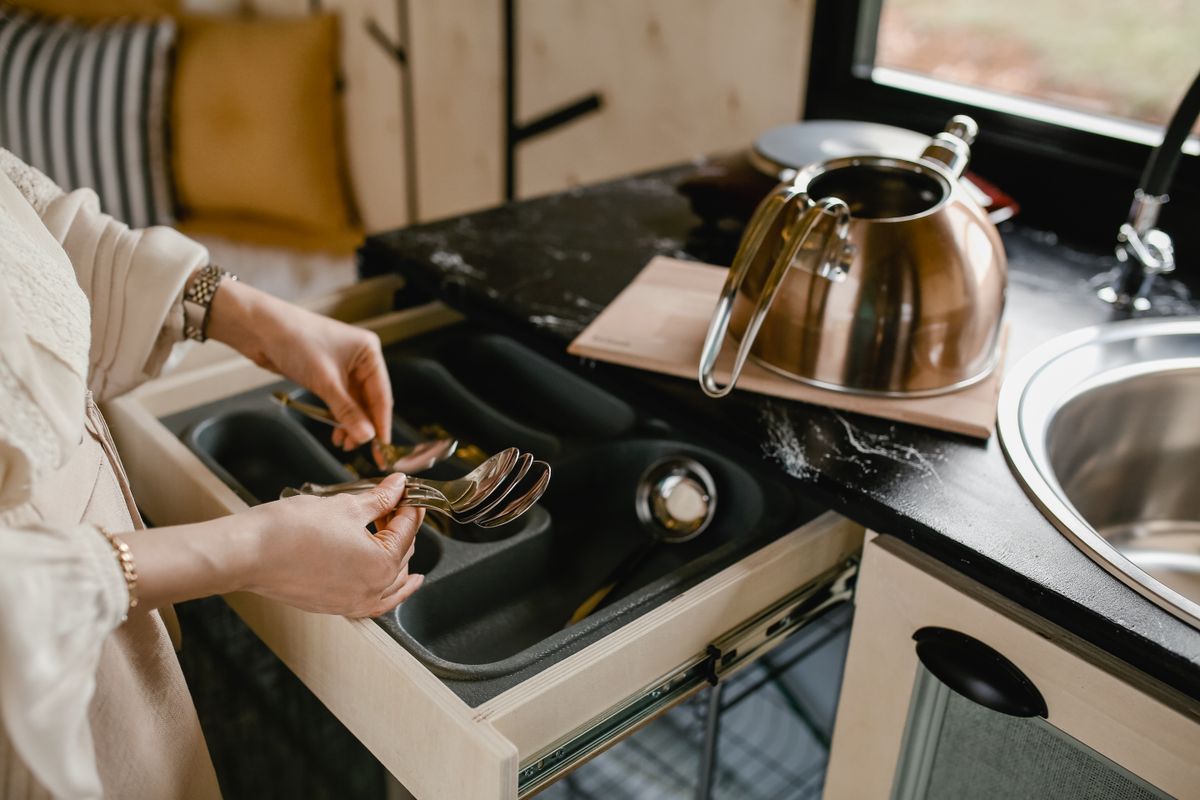
Drawers are more expensive in depth than doors. A 14-inch cabinet gives a drawer box around 12 inches deep once the slides and the front are accounted for, and a standard cutlery tray at 17.75 × 11.75 inches fits that with a quarter inch to spare. A 16-inch drawer liner does not. If the sideboard is going to be the cutlery store, check the drawer’s internal depth rather than the cabinet’s.
Most sideboards put drawers in the top third and shelves below, which is the right way round for depth: the drawers hold the small dense items that fit any depth, and the shelves hold the plates that need the height.
Measuring the sideboard you already own
Measure the interior depth at three heights, at the shelf and near the top and bottom, because a back panel may be inset and a carcass is rarely square. Take the smallest reading as your working depth.
Then measure the clear height above and below each shelf, including the shelf’s thickness, and check whether the shelf is adjustable. If it sits on pins, moving it up 2 inches costs nothing and may solve the problem without a new piece of furniture. Cabinet shelf risers and stacking covers what to do when the gap is fixed and the plates are too tall.
Finally, measure the tallest plate with a ruler across its face rather than trusting the size on the box, and add an inch. A dinner service sold as “10.5 inch” is often 10.75 at the rim, and a quarter inch is exactly the margin that a 12.5-inch interior does not have.
For the general version of this arithmetic, including why the front 12 inches of any shelf are the only ones you can reach, the twelve-inch rule is the place to start.