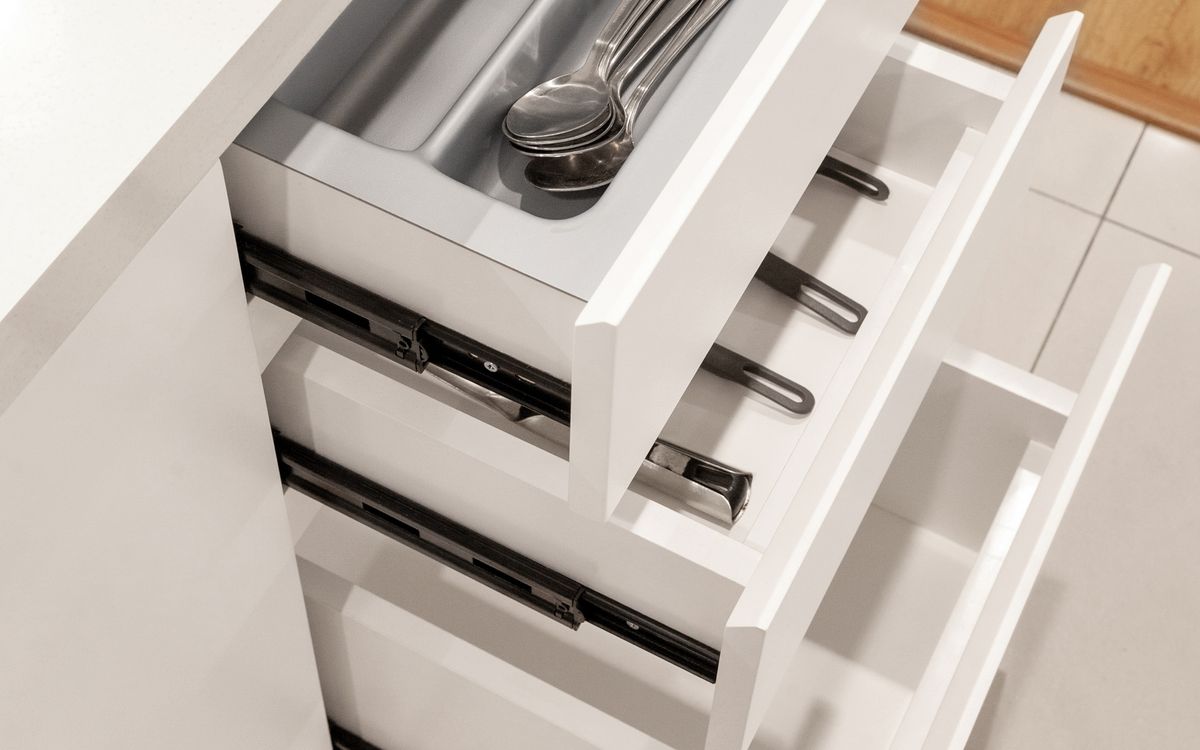
A pull-out shelf is a drawer without a box. It is a board on two slides, and every pound you put on it travels through those slides into four or six screw holes in the cabinet sides. That is the whole structure, and it explains why the load rating on the box is almost never the number that fails first.
Three figures decide whether an install lasts: the rating of the slide pair, the thickness of the cabinet gable you are screwing into, and whether there is anything solid at the back of the cabinet to fix to. None of them are on the shelf’s packaging.
The slide rating is per pair, and it assumes a still load
Slides are sold in pairs and rated as a pair, usually at 50, 75 or 100 pounds. The rating is a static figure, measured with the load centred and evenly distributed, and it usually assumes the shelf is not being yanked.
Two corrections apply in a kitchen. The first is dynamic load: pulling a 60-pound shelf out at speed and stopping it at full extension puts a multiple of 60 pounds through the front screws for a fraction of a second. The second is distribution. A shelf loaded with cans at the front and nothing at the back loads the slides unevenly, and the front pair of rollers takes most of it.
Under-mount concealed slides are rated differently from side-mount ball-bearing slides, and the number is often stated per pair as a single load. The Rev-A-Shelf 53WC double pull-out, for example, uses under-mount soft-close slides with a 90-pound rating, carries two 35-quart bins, and publishes a minimum cabinet opening of 14.5 inches wide by 22.125 inches deep by 20.25 inches high. That last figure is the cabinet’s inside height, not the unit’s height, which the manufacturer lists as 19 inches.
Full extension matters as much as load. A three-quarter-extension slide leaves the back third of the shelf inside the cabinet, which defeats the point of a pull-out in a 24-inch-deep base cabinet. Pay for full extension before you pay for a higher load rating.
A half-inch side panel cannot take the same screw as a three-quarter panel
Cabinet sides — gables — come in two thicknesses that matter. North American face-frame cabinets are commonly built with 18 mm (about 3/4 inch) gables. Imported and ready-to-assemble cabinets are often 12 mm (about 1/2 inch), and some are 15 mm.
The difference is how much material a screw has to bite into, and whether it can break through the finished outside face of the cabinet.
| Gable thickness | Material available | Longest safe screw | Failure mode |
|---|---|---|---|
| 18 mm (3/4 in) | About 11/16 in after the slide flange | 5/8 in | Screw pulls out under shock load |
| 15 mm (19/32 in) | About 1/2 in | 1/2 in | Screw tips out and splits the panel edge |
| 12 mm (1/2 in) | About 7/16 in | 1/2 in, or through-bolt | Point breaks the outside face |
On a 12 mm gable, a 5/8-inch screw leaves the point about 3/16 inch proud of the outside face — visible on the side of the cabinet, or through the finish if the cabinet is painted. The fix is a shorter screw with a wider head, or a through-bolt with a washer and a cap on the outside. Through-bolting is the stronger joint anyway, and it is the right answer for any shelf carrying more than about 40 pounds.
Particleboard and MDF both hold a screw less well than plywood, and both crumble when a screw is driven in and out more than once. If you drill a hole in the wrong place, move the shelf up or down rather than reusing the hole.
The rear fixing point is not the back panel
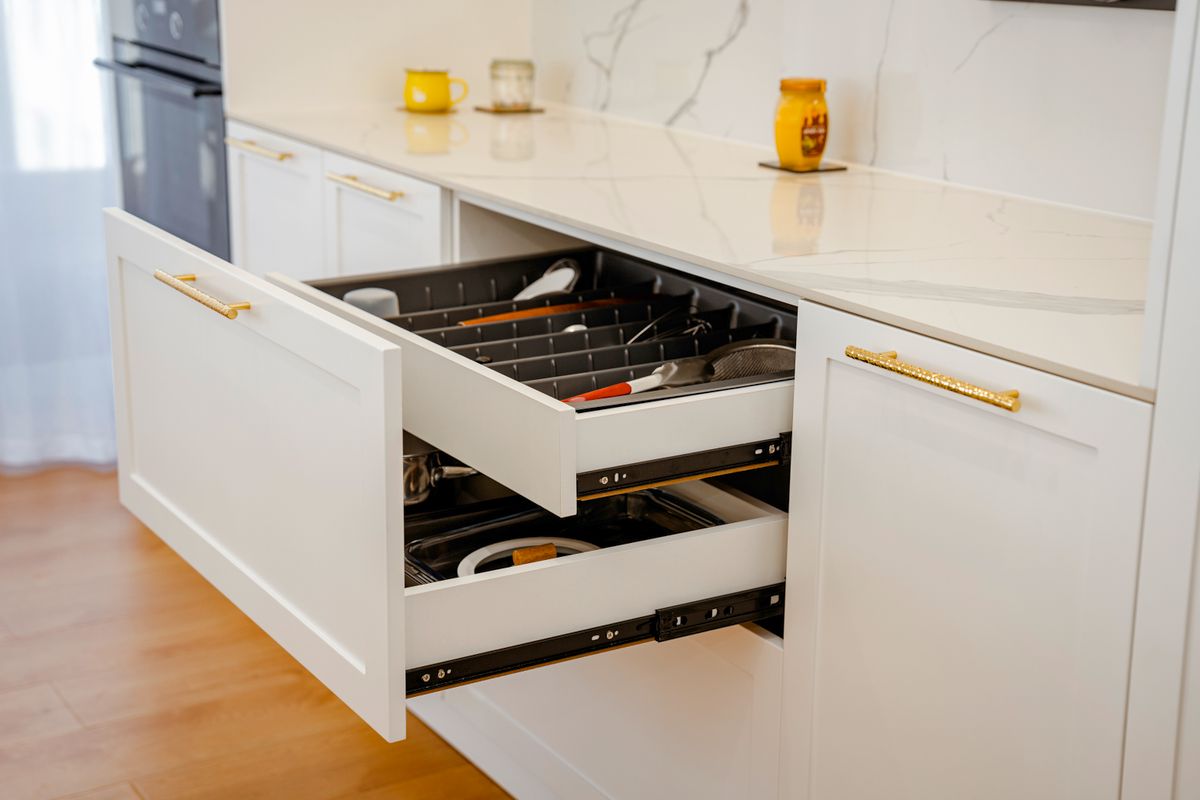
Most base cabinets have a 1/4-inch hardboard back panel stapled or nailed to the gables. That panel carries no vertical load, and a screw into it will pull out with a shelf full of jars.
The rear fixing has to reach structure. In a face-frame cabinet there are three places: the rear hanging rail along the top of the cabinet, the face frame itself at the front, and the two gables at the sides. In a frameless cabinet, the gables are the only structure, plus the rear rail if the manufacturer fitted one.
That is why the rear screws go into the gable, not the back. The slide flange is long enough to reach the rear of a 24-inch cabinet, and the rear screw simply goes into the same side panel as the front screw, 18 to 20 inches further back. If the cabinet has a mid-rail or a fixed shelf, a third fixing into that is worth adding.
Where the cabinet has no rear structure at all — some RTA units are open at the back — the shelf itself has to act as the brace. Use a shelf board at least 5/8 inch thick, and fix a cleat to the wall behind the cabinet if the wall is accessible.
Clearance: an inch across, two inches behind
Slides need clearance, and the numbers are not negotiable.
Side-mount ball-bearing slides typically need 1/2 inch of clearance on each side of the drawer box or shelf. That means a shelf in a 15-inch-wide opening is at most 14 inches wide, and a shelf in an 18-inch opening is 17 inches wide. Under-mount slides take their clearance from below rather than the sides, which is why they are popular in bins and less common under a flat shelf.
Behind, a full-extension slide needs the cabinet to be deeper than the shelf by the thickness of the slide’s rear bracket plus a little air: 1 inch is the working minimum, 1.5 inches is comfortable. In a 24-inch base cabinet with a 3/4-inch door in front and a 1/4-inch back panel behind, a 21-inch shelf is about the maximum.
Above, the shelf needs the height of the tallest item you intend to store, plus the thickness of the shelf above it. A 10-inch-tall cereal box does not go into an 11-inch gap if the board above is 3/4 inch thick.
The load your pantry actually puts on the shelf
Canned goods are the densest thing most people put on a pantry shelf, and they are easy to count. A standard 15-ounce can weighs about a pound; a 28-ounce can of tomatoes is about 1.75 pounds. Thirty cans — six rows of five on a 20-inch shelf — is roughly 40 to 50 pounds.
Add the shelf board, roughly 8 pounds for a 5/8-inch board 20 inches deep and 16 wide, and the working load is around 55 pounds. That sits inside a 75-pound slide pair and outside a 50-pound pair, which is the practical dividing line: a grain and can shelf wants a 75 or 100-pound pair; a shelf for boxes of cereal, packets and baking trays is fine on 50.
Glass jars are the other extreme. A quart jar of preserves is about 2 pounds, and a shelf of twelve is 24 pounds in a small footprint — heavy per square inch, which is what dents a thin shelf board rather than what breaks a slide.
The install sequence, in order
Measure the opening at three heights and take the smallest width. Cabinet boxes are rarely square, and a 1/8-inch taper is normal.
Decide the shelf positions from the items, not from the holes. Mark the slide height on both gables with a combination square, using the front edge of the cabinet as the reference, not the back.
Drill pilot holes. On particleboard and MDF this is not optional; a screw driven without a pilot hole will lift the laminate and split the panel.
Fit the slides to the shelf first, then the shelf to the cabinet. It is much easier to align two slides to a board on a bench than to hold a board and two slides in a cabinet at once.
Test with the load before you commit. Put the actual cans on the shelf, extend it fully, and watch the gap between the shelf and the cabinet side. If the gap closes at the front, the front screws are too small or the shelf board is flexing.
When a pull-out is the wrong answer
A pull-out is the wrong purchase in three situations.
The first is a cabinet narrower than 12 inches inside. There is not enough width for a useful shelf plus the slide clearance, and a fixed shelf with baskets does the same job for less.
The second is a cabinet with a drawer above it and no room to lose. A pull-out needs vertical clearance equal to the tallest item plus the slide, and the drawer above already took the top of the opening.
The third is a shelf holding liquids. A pull-out that is yanked spills a bottle of oil across a cabinet floor, and no slide rating accounts for that. Fixed shelves with a lip, or bins that lift out whole, are the safer choice for anything that pours.
The alternative to a pull-out in a narrow cabinet is a lazy susan in a corner, which trades reach for rotation. The trade-offs between the two are set out in lazy susan versus pull-out. For the depth question that decides shelf width, start with pantry shelf depth, and if the door is where your storage is going instead, read pantry door storage.