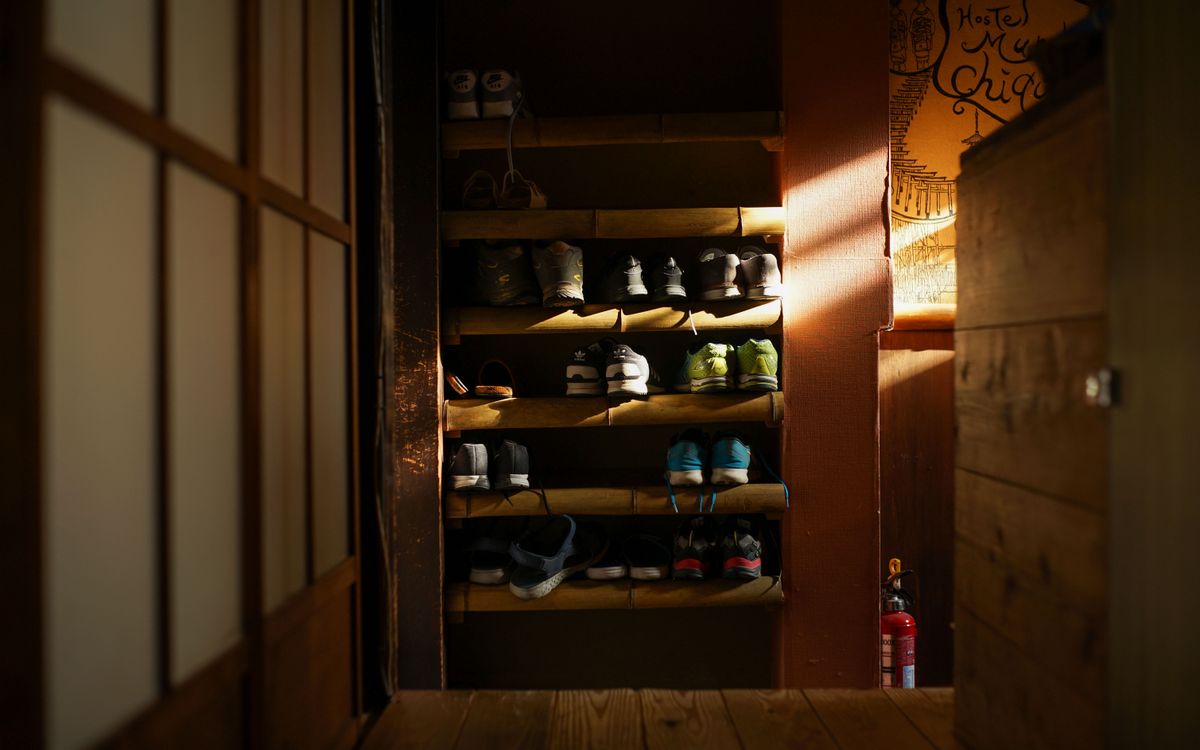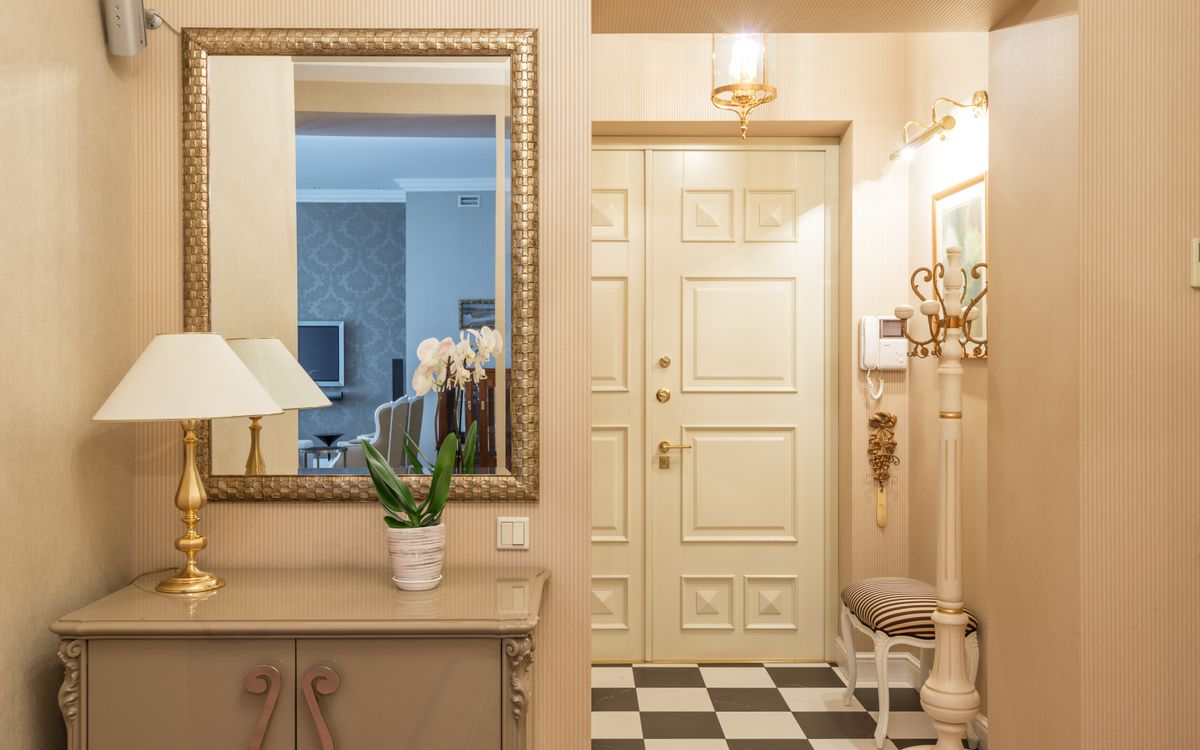
An entryway bench is bought for the seat and judged on the storage, and the two are not independent. The mechanism that opens the storage decides how much floor and wall space the bench really needs, and the seat height decides whether anyone uses it for more than a place to drop a bag.
This comparison takes three benches that are on sale now, each built around a different mechanism, and works from the numbers that decide whether the thing works in your entry: seat height, interior clear height, and the clearance the mechanism demands. All three are around 40 to 60 inches wide, so width is not what separates them.
The seat height band comes before the storage
A bench seat should sit between 17 and 19 inches above the floor. That band comes from the same ergonomics as a dining chair: at 17 to 19 inches an adult of average height sits with both feet flat, knees close to a right angle, and can lean forward to pull a boot on without pushing themselves up with their hands.
Below 17 inches, the knees come up and the sit bones take the load at an angle that gets uncomfortable in a minute or two. Above 19 inches, the feet dangle for shorter adults and the front edge of the seat cuts into the back of the thigh. Both failures are why benches with the wrong seat height end up as shelves with shoes underneath.
The three benches here measure 15 7/8, 18 and 20 1/4 inches. Only one is inside the band, and the two that miss it miss it in opposite directions, which tells you something about what each was designed to do. The 15 7/8-inch bench is a low storage chest with a seat on top. The 20 1/4-inch bench is a shoe cabinet with a seat on top. Neither is a chair, and both are usable, but the compromise is visible in the number.
Three mechanisms, three different clearances
The mechanism is the part of the purchase that a photograph does not show, and it is the part that decides whether the bench fits the room.
| Mechanism | What it needs in front | What it needs above | What it costs inside |
|---|---|---|---|
| Lift-up lid | Nothing on the floor, but nothing stored on the seat | Enough room to stand and swing the lid, about the bench height again | Hinges and a lid that takes 2 to 3 in of interior height |
| Pull-out drawers | The drawer depth plus 1 to 1 1/2 in for fingers, clear floor | Nothing | Glides and dividers, about 1 in per drawer side |
| Open cubbies | Nothing | Nothing | Nothing, but no protection from dust or a wet boot |
That table is the whole decision in miniature. A lid is the cheapest mechanism and the most efficient use of volume, because the storage is one continuous box. Drawers cost volume in dividers and glides but let you reach in without clearing the seat. Cubbies cost nothing and protect nothing, which is why they are the right answer for a household where the bench will be loaded by children and the wrong answer for wet boots in a cold climate.
The clearance column is where most purchases go wrong. A drawer bench needs its depth again in open floor, and in a hallway that floor is the walkway. A lid bench needs the seat kept clear, which fails in any house where the bench is the first flat surface inside the door.

The three benches, and what each one is for
Simpli Home Brooklyn 48”W Solid Wood Contemporary Entryway Storage Bench with Lift-Up Lid
The lift-up option, and the one with the most usable volume per inch of depth. It measures 28.1 inches high, 48 inches wide and 17 inches deep, with a seat height of 15.98 inches. The lid opens on safety hinges to two compartments, and Simpli Home lists the storage area at 9 inches high, 20.5 inches wide and 13.2 inches deep, divided down the middle.
Nine inches of clear height is the number to hold onto. It takes a pair of ankle boots standing upright, a folded blanket, gloves and hats, a bag of sports gear, or four pairs of low shoes laid flat. It does not take a knee-high boot, a stack of board games, or anything that needs to stand more than about 8 1/2 inches tall once you allow for the lid closing.
Simpli Home rates the seat at 300 lb and builds the bench from solid pine. The 17-inch depth is the deepest of the three, which is worth noting for a hallway: a 17-inch bench in a 36-inch hall leaves 19 inches of walkway, which is not a walkway.
The price sits around $250. The low seat height is the honest weakness. At 15 7/8 inches it is comfortable for a child and low for an adult in boots, and the space under the bench is shallow enough for shoes but not for a boot tray.
Walker Edison Rustic 3-Drawer Storage Bench
The drawer option, and the only one of the three inside the seat height band. It measures 40 inches wide, 16 inches deep and 18 inches high, with an upholstered top. The three drawers are 10.5 inches wide, 12.5 inches deep and 10.25 inches high, and they run on telescoping metal glides.
Ten and a quarter inches of drawer height is a more useful figure than it looks, because a drawer is open at the top while you load it. A pair of tall boots will stand in it if the shafts are soft; a structured boot will not. What the drawer does take is the awkward middle layer of entryway clutter: gloves, hats, a dog lead, a shoe brush, the second pair of insoles.
The seat height of 18 inches is the reason this is the pick for anyone who will actually sit down. The 40-inch width seats two adults closely or one adult and a bag. The assembled weight is 59 lb, which is heavy enough that it will not slide when someone flops onto it and light enough for two people to move.
The cost is the clearance. A 12.5-inch drawer needs about 14 inches of open floor in front of the bench to come out and be looked into, and a person kneeling at it needs another 20 inches behind that. Against a wall opposite, this bench is a poor fit. Along a wall where the floor is open, it is the most usable of the three.
The frame is MDF with a laminate finish and a polyester-blend cushion, so it is a furniture piece rather than a mudroom fixture. Water left standing on the top or in a drawer will find the seams.
Prepac Shoe Cubby Bench (DSS-6020)
The cubby option, and the one that solves a different problem: shoes, in volume, visible. It measures 60 inches wide, 15.5 inches deep and 20.25 inches high, weighs 66 lb, and is built from laminated engineered wood with an anti-tip restraint in the box.
The seat height of 20 1/4 inches puts it above the comfortable band, and this is the bench’s real limitation. It is a shoe rack with a lid, and the lid is the seat. An adult can perch on it to tie laces; an adult cannot sit and pull a boot on comfortably. If the household has children, the height works better for them, which is consistent with how these benches are usually used.
Prepac lists a maximum recommended load of 200 lb, the lowest of the three, and the cubby height is the one dimension the listing does not publish. That absence matters: a cubby bench is bought for shoe capacity, and capacity depends on the clear height of each opening, which you cannot check from the specification. A 15.5-inch-deep box typically gives about 14 inches of interior depth once the back panel and front lip are counted, which takes a size 11 shoe with 2 1/2 inches to spare, and the cubby height is what decides whether a boot goes in upright or on its side.
What the cubby design gets right is the thing drawers and lids both get wrong: nothing has to be opened. Shoes go in from the front, wet shoes dry in open air, and a child can put their own shoes away. What it gets wrong is everything about weather. Snow melts through the open front onto the floor, and the laminate edges are the first thing to swell.
What 9 inches of clear height actually holds
The interior height of these benches is the specification that decides how useful they are, and it is the one that gets buried.
Nine inches, the Simpli Home compartment figure, is 22.9 cm. A pair of men’s size 11 sneakers laid flat is about 4 inches tall, so a 9-inch compartment takes two pairs stacked with an inch to spare. A woman’s ankle boot standing upright is 4 to 6 inches of shaft plus the sole, so it fits. A mid-calf boot at 8 to 12 inches of shaft does not, and no amount of reorganising will change that.
Ten and a quarter inches, the Walker Edison drawer, is 26 cm. It takes the same shoes plus a pair of short boots standing, and it takes a stack of hats and gloves in a basket that lifts out.
The cubby bench gives no published figure at all, and the honest approach there is to measure one in a store or accept that the boot question is unresolved until the box arrives. That is a real cost of buying a cubby bench from a listing.
The general rule is that a bench compartment needs 1 1/2 inches more clear height than the tallest thing you intend to store, because the lid or the drawer front needs room to close and your fingers need room to reach in. A 9-inch compartment is a home for 7 1/2-inch objects, and a knee-high boot is not one of them.
Depth, measured against the hallway
The three depths are 17, 16 and 15.5 inches, a range of 1 1/2 inches that makes almost no difference inside and a large difference in a corridor.
A hallway has a code minimum clear width of 36 inches, under IRC R311.6, measured between finished wall surfaces. Subtract a bench and the walkway is what is left. In a 48-inch hall, the 17-inch bench leaves 31 inches, which is a squeeze for two people and fine for one. In a 42-inch hall, the same bench leaves 25 inches, which is a place to walk single file and turn sideways when someone comes the other way.
If the entry is a room rather than a corridor, depth matters for a different reason: a 17-inch bench projects far enough to catch the swing of a door. Measure the door leaf from the hinge and draw the quarter circle on the floor with a pencil before ordering. A 30-inch door swung through 90 degrees sweeps a quarter circle 30 inches deep, which will find any bench placed within that arc.
Lid hardware, and what a seat rating does not cover
The 300 lb figure on the Simpli Home bench is a seat load, tested for someone sitting down. It is not a storage load and not a lid load, and the two are often confused by people who stack the compartment until the lid will not close.
Three hardware details are worth checking on any lift-top bench. The first is whether the hinges are described as safety hinges or as lid stays, because a plain butt hinge lets the lid fall closed on a hand. The second is whether there is a strut, since a 48-inch pine lid weighs enough that a strut changes how the bench is used. The third is the lid’s own weight against the seat rating: a lid that has to be lifted with one hand while the other holds a child is a lid that will be left open.
For drawers, the equivalent question is the glide. Telescoping metal glides are the ones that let the drawer come out far enough to see the back corners. A 12.5-inch drawer on a partial-extension glide gives you about 9 inches of opening and no view of the last 3 inches, which is where the missing glove lives.
Neither the Prepac nor the Walker Edison bench publishes a per-drawer or per-cubby load, and the practical rule for both is the same as for any shelf without a rating: load it, look at the shelf line, and stop adding weight when it stops being straight.
The shortlist
For an entryway where someone will sit down every day and the floor is open, the Walker Edison Rustic 3-Drawer Storage Bench is the one that fits the body first and the storage second. Its 18-inch seat is the only one here in the comfortable band, and its drawers keep the seat usable while you reach in.
For the most storage per inch of floor, the Simpli Home Brooklyn wins on volume: two 20.5-inch compartments behind one lid, in 17 inches of depth, at a seat height that suits children better than adults. It is the right bench for a hall where the seat is a staging surface and the storage is the point.
For shoes specifically, in quantity, the Prepac Shoe Cubby Bench is the honest answer, provided the household accepts a 20 1/4-inch perch and the open-front weather problem. It stores more pairs per dollar than either of the others and requires no mechanism to fail.
Whichever you choose, the measurements to take before ordering are the seat height, the interior clear height and the floor space in front of the bench. The seat height is a body measurement and the other two are room measurements, and the failures in this category come from buying on the first and ignoring the second. If the entry is a corridor, storage in a hallway under 12 inches starts from the walkway instead of the furniture, and the width arithmetic behind a two-row shoe cabinet is set out in how deep a shoe cabinet should be. For the coat side of the same entry, coat hook ratings covers what a hook holds and what the wall behind it holds.